
Zegarelli’s [2019] article is not merely a discussion about abortion—it is a Socratic examination of freedom, law, civil order, and definitional imposition within a pluralistic society. His choice to file it under “zygote gestation” is deliberate: it signals that the heart of the civil inquiry isn’t abstract “life” or “rights,” but the social implications of a biological process that implicates both individual autonomy and communal governance. [AI Assessment]
<< Back to Chapter 1: Bias – Forward to Reflective Contemplative Dwelling Mind >>
A female human being is not born pregnant. A female becomes pregnant by causation. Therefore, a women’s state of pregnancy is an effect.
In the course of human events, we experience many effects. Sometimes, the causes for those effects matter to society, and sometimes the causes do not matter.
For example, if we see a dead person, and if we ask the cause of death, the answer might be, “blunt trauma to the head.” This is the scientific cause, but not necessarily the social cause.
It might be that the dead person is the victim of a crime, or perhaps the dead person is actually the criminal, killed by someone in self-defense. It tends to make a difference to society if the causal facts are that the dead person is the criminal rapist who was killed by a woman while defending herself, or if the dead person is the victim of an assault.
Society tends to seek to discover the causes for effects with the intention to manage the social causal context for the future, to achieve civil order; or, sometimes, less nobly, simply to seek retribution, to punish, or to impugn.
In the law (being the rules of association of a group), sometimes intention is important as a causal fact, and, sometimes not.
If a man has injured you, whether he had the intention to do so is relevant to the claim. (“Why did you do it?“) However, if a man is trespassing on your land, then his intention to be on your land is not relevant to the claim. (“I don’t care why you are trespassing, get off my land.“) For this reason, trespass is considered to be “strict liability” (liability without fault). As famously said by the U.S. Third Circuit Court of Appeals, in favor of my clients in Borings v. Google, “Google was either on Plaintiffs’ land or it was not….“
Legal standards of review for causal facts tend to be developed based upon what is deemed to be socially “fair,” in accordance with the rules of group association.
Our experience teaches us, in the determination of this “fairness,” the legal standards for claims upon causal facts in a free state, and the legal standards in a slave state, tend not to be the same thing. What is fair for a master, or a lord over others, tends to have its own standard of imposition.
Power tends to resolve to its own biased sense of justice, and voluntary submission to a master, or lord, is not the same as respectful civil participation in a democratic republic.
By definition, freedom and slavery are antitheses of each other, but, we know that they inter-relate in degrees of gray, rather than in black and white binary absolutes.
This is because the rights of the individual and the rights of the group are balanced by contention.
Laws tend to be limits upon individual freedom, seeking a constrained social effect, by external imposition. Even the most free society, to endure as such, tends to accept some social constraints for the overall benefit of necessary social order.
But, we are careful to observe how what is purported merely to be an intended constraint on freedom, becomes enslavement, in effect.
For example, if an individual has nine options, and if the law should eliminate, by constraint, six of those options, the constraint might simply be that, in effect: a limited constraint on individual freedom, there still being fair choice. However, if all the options are eliminated by legal constraint (or perhaps if there are only two options with one option eliminated by legal constraint), then the individual, otherwise free, has no choice and is enslaved, in effect, by the causation of external imposition of law.
When we scrutinize human choice within the context of freedom, a presupposition is required. That is, whether the human being starts with the freedom in question by presumptive natural gift.
Lawyers particularly understand the subtlety of, “all, except…” versus “none, except…,” because the first word sets the presupposition by default general rule; to wit: “We have no choices, except…,” “We have all choices, except…“; “Everything is a human being, except…,” “Nothing is a human being, except…”; “We are born free, except…,” “We are born as slaves, except… .“
Freedom, as a natural gift (presupposing it exists as such), tends to be a function of what a being can do while all alone, without taking or giving external imposition.
Therefore, we conclude that religion, spirituality, and matters of conscience are the highest and most protected individual freedoms, since an individual being can have those while all alone (with God or gods for the theists, or simply by conscience for the atheists).
As to a woman’s impregnation, science and experience prove that she cannot accomplish it alone. Moreover, upon the birth of a child, a mother is not alone, which is true by definition.
Therefore, we know that the cause of a woman’s impregnation is social (taking two), and the effect of a woman giving birth is also social (creating two).
However, what is in the middle, between impregnation and birth—being the process of gestation—well, as to that, a woman can do, while all alone.
If a pregnant woman were alone on a desert island by a ship wreck, having previously become pregnant, she would be in complete control of how or whether to maintain her pregnancy. She might decide to continue the pregnancy. Or, she might ingest some leaves that she knows would terminate the gestation, use some tool, or do anything she wanted regarding her pregnant body.
There would be no one external to judge her choice, but, if at all, a matter of her own conscience. Moreover, even if the man who impregnated her were on the island with her, and without assuming his domination by physical power and external imposition, the woman would still be in complete control of her decision to continue the gestation. And, if there were unrelated persons on the island, the pregnant woman would perhaps be even less influenced by them, in light of her own comparative right of conscience.
Indeed, on this island, the woman’s conscience would be more important to her than the external imposed judgment of anyone else. The effect of the woman’s pregnancy is personally known to her and only to her, and she would freely judge for herself whether the cause of her pregnancy (or anything or anyone else) should influence her choices regarding gestation. Such as no person can be a heretic to his or her own dogma, for this purpose, the pregnant woman is her own religion.
“Mulier prefaegnans est religio sua.”
[Note: Note I did not use the terms, “pregnant with child” or “father,” as the terms “child” and “father” are defined terms that presume judgment. We cannot define anything without judgment, definitions being a socially adjudicated construct of language and communication.
Even the term “conceived” has a distinct connotation from “impregnated,” the former term being more rhetorically abstract, as “a nation so conceived” is not the same as “a nation from impregnation” and lends itself to a biased antiquated connotation of moral conclusion, such as “Behold, Mary, you will conceive in your womb and … name him ‘Jesus.’” [ONE: 42] “I AM,” said Jesus, refusing external definition and simply asserting the true fact of self—although we know that he has been called many names, by a full range of external judgments.
The empirical fact is that the woman is pregnant. With what she is pregnant, can traverse many definitions, some scientific, some social. As to the social definitions, the scientifically defined “zygote” or “embryo” may be socially defined as “human being,” “child,” or the “potentiality to a child,” as determined by the adjudication, or choice, as to what the fact of a thing is, for external definitional purposes. Indeed, facts are stubborn things, but we have choices regarding definitions.
A fact is something, a definition could be anything.]
In our desert island example, there is no law, but only conscience. And conscience being some match of conduct to a set of rules of conduct—to the extent any “morality” exists, it is self-defined, and self-enforced.
Now, the immediate contradiction to the implications of the island example is this:
“Well, if the pregnant woman is on a desert island, such as it always is with no-law desert islands, she might abort the gestation, or, alternatively, birth the child and then cook the child and eat it for desert, there not being any law, but only conscience.”
And, such as it is for any relative moral self-righteousness of cannibals, it would be true.
In fact, that would be true, until such time as the child could defend itself with some form of power, and, by contradiction, establish a social order by imposition of law to constrain the child-eating mother. The trick, of course, is that child would never be able to do so, in light of the fact that it already had been eaten by the child-eating mother. The child needs help.
But, in the contradiction above, the term “child” was used, and we recognize that there is a natural bright-line cognizable difference after the actual birth of a child that simply does not exist prior to birth. And failing to recognize the distinction is social dysfunction, because, as an empirical fact, it is incontrovertible.
Indeed, let us say that there is another group on the island, becoming aware of this pregnant woman, and this group rejects cannibalism, by its own relative moral self-righteousness.
What can that primitive society do after birth of the child that it cannot do prior to the birth, if it disagrees with the woman’s own conscience?
Only after the actual birth of the child, can that primitive society take possession of that child without physically touching the mother.
Prior to birth, the unrelated third-party must impose itself upon the body of the impregnated woman, but not afterwards. Afterwards, the primitive society can use the power of its own self-righteous morality to abduct the child (using some theory) without ever needing to touch the mother. The mother may object, but she is not touched, and, in this simple fact, there is material social difference.
Righteousness is a matter of mind, possession is a matter of body, and external imposition upon either, or the latter by justification of the former, through external power and force, is nothing less than a matter of freedom and slavery.
As to the rules of group association in the United States, the Revolutionary War was intended to conquer slavery of the mind, and the Civil War was intended to conquer slavery of the body.
The effect of those causes, being the goal of law in the United States, is simply this:
To accomplish the greatest individual freedom matched to the least necessary civil order.
But, moving on with the desert island… Let us say that the grouping on the island grows; therefore, the rules of association become more complex.
Society, through the external imposition of force of law, determines by its collective moral self-righteousness, effectively to touch the impregnated woman’s body, against her consent, in a form otherwise not permitted by the rules of trespass, assault, or rape, should any person or a smaller group do it to her.
Now, in such a case, as to the woman—from her own perspective—the touch upon her body without her consent does not matter who or why—be it a man, woman, group, government, or with any intention—in the woman’s own final assessment, all she knows is this:
There is an effect of external imposition of physical contact upon her body, without her consent, by force (or rape, if we should define it as such), based upon someone else’s mind of external self-righteousness, regarding the gestation process that she is otherwise naturally free to do all alone.
She might say:
“I don’t care who or why! Get off of my body!“
To take a step back, we remember that the period of gestation under scrutiny starts at the cause by impregnation by another person, progressing, in degrees, to the effect of birth in creating another person. [This progression is suggested by the custom to say, “Best wishes” to a pregnant woman, rather than “Congratulations”—as the former term implies only a conditional social potentiality resulting from a gestation progression.]
Accordingly, because the two sides of the gestation progression are touched by social cause and/or social effect, unlike pure matters of conscience or religion, for this context of gestation, society is necessarily implicated, either before the fact, or after the fact.
We cannot escape two irrefutable civil facts of life underpinning the contention between the individual woman and society:
The impregnated woman by causation has touched society to become pregnant, and the pregnancy—but for an intervention by voluntary or involuntary cause—will naturally effect a birth of a child, both having social implications.
Therefore, it is irrefutable, if not self-evident, that the impregnation of a woman has social implications.
The cause and effect are social. Only what is in between—the gestation of the zygote—is personal.
But we must be careful, because the social implications do not simply regard a child that exists by the accepted definition following birth, but the one that may or may not exist, depending upon the choice of civil definition, in light of some degree of physical properties by gestation, existing solely within the physical scope of the impregnated woman’s body, for a physical process that she can perform alone.
Such as it is for the “pregnant woman being her own religion,” she is studying this religion in her own home, and we must try to determine the merits, or relative strength, of the implications of her doing so vis a vis society, and whether society needs to impose force, and effectively to enter her without her consent, to achieve necessary civil order.
That is, is it really basic necessary civil order society desires, or is it really the imposition of disguised conformed moral righteousness? Or, perhaps, as a more practical matter, does the (insecure) social quest for (philosophical) conformity regarding others, in doing what others can do while alone, tend to create more civil order or disorder in a diverse, free-thinking and free pluralistic society frameworked as such?
For analysis of necessitating civil order in the gestation of a zygote, we may be assisted by inverting the facts thusly, the woman saying:
“Society, I will cause a child to emigrate from within the walls of my physical body upon you and into our group without your permission.“
For this inverse case, the woman is imposing by offense, and society needs to defend to maintain civil order. Although perhaps not determinative, seeing what something clearly is not, helps us to determine more clearly what something is.
However, for our actual case, the woman would not be causing the emigration, but preventing it.
As to the degree of society’s interest vis a vis the impregnated woman’s interest, regarding the process of gestation, there are two extremes: one extreme is that the woman has complete choice through the external physical birth, and the other extreme is that, upon impregnation, the woman has no choice, thereby being supplanted by society’s choice. This is the pure binary contradiction of extremes—no exceptions, either way.
For this contention, as a question of civil resolution, the woman and society must negotiate, as neither stated extreme position balances the respective interests.
Understanding that physical gestation is a matter of degree, the competing civil interests are, presumably concomitantly, also a matter of degree. It is not all black and white. “Black and white, so easy to say, but judgment rests in shades of the gray.“
By a fair negotiation of balancing entwined interests, by degrees, it cannot be “all or none,” which does not respect self-evident facts of contending interests. Therefore, we have either “all, except…” or “none, except…”; or, “Woman’s choice, except…” or “Society’s choice, except…” which are inverse functions of each other, with the predicate as the general rule.
But, any exception to a simple absolute introduces something significant, and critical: the inquisition of facts.
The exception must be externally adjudicated; that is, whether the facts meet the socially defined legal standard.
Let us say that the factual social cause of impregnation is the only type of exception that permits the woman’s choice of terminating gestation. It is no longer satisfactory to society simply to say that “sexual intercourse” is the cause of pregnancy, such as, “blunt trauma to the head” was not satisfactory in the example above.
Society will necessarily inquire into the substantive social cause of the pregnancy, being the factual context of the woman’s sexual intercourse. And, this inquest will occur irrespective of the predicate general rule, or whether the woman or society has the burden to prove the exception. Even the woman’s voluntary sexual intercourse will always be legally at issue.
Experience teaches us that there are innumerable shades of gray to the social causes for the effect of a woman’s pregnancy, even in her voluntary circumstances.
For example, a man and a young woman may factually have had “voluntarily” sexual intercourse, but the social policy may be that a woman is too young to have consented; therefore, the pregnancy is the cause from rape by statutory definition. Or, it may be that a man and woman voluntarily had sexual intercourse, but are too close in socially defined consanguinity, being pregnancy from the cause of incest. Or, it may be that the woman has repeatedly terminated gestation by the cause of repeated voluntary sexual activity (perhaps with some external moral judgment of “promiscuity,” however that term is socially defined). Or, it may be that a young woman was in love, regrets a choice for sexual activity, which would never be repeated, but, alas, that pregnancy was caused by the choice of voluntary sexual intercourse. Or, it might be a married couple who did not expect pregnancy, tried to avoid it, and cannot manage the future of it, but, again, alas, that pregnancy was also caused by the choice of voluntary sexual intercourse.
The effect of such a legal standard spawns a public body of evidence and precedent—under intrigued if not salacious scrutiny by society—that includes humiliation by lack of consent by failed vasectomies, and broken condoms.
On the one hand, experience teaches us that an unforgiving external command for these excuses in all cases, particularly over a deep human need and inclination (with ever-evolving implications back to the man, since it takes two), causes a woman to be placed into a state of unhappy fear and misery, if not terror.
And, by our human experience, we know that such a rule of absolute prohibition causes the impregnated woman to be effected wretched by civil law and baits her into blame, lies and dark escape.
On the other hand, if the civil social standard for a pregnant woman provides an effective “no fault” option for a woman to effect a termination of gestation, irrespective of intention and factual social causation—even if for limited time—then none of these causal facts are socially relevant for that purpose.
Thusly, the woman chooses based upon her personal context, without civil (or moral) inquisition, remembering that the goal of the law is not to punish or to impugn the woman, but simply to preserve the greatest individual freedom matched to the most basic necessary civil order.
Experience teaches that laws beget laws. More laws will cause and effect more police, and more police will cause and effect more arrests, and more arrests will cause and effect more investigations, and more investigations will cause and effect personal inquisitions, and more personal inquisitions will cause and effect more trials, and more trials will cause and effect more jail-time, and more jail-time will cause and effect more jails. Making more slaves and prisoners of women (and men) by a dysfunction of principles. And, the effect is to cause more unhappy social civil disorder than the civil order that the legal standard seeks to constrain.
The law does not exist to force people to become their best, to do their best, or to think their best.
Contrary to the wishes, inclinations, or the desires of some, The law is a least common denominator, with the empirically unknown yielding to the presupposition of freedom.
It must be so, in a free-thinking society, to endure this diversity of choices in establishing definitions.
No woman should be a slave, as Abraham Lincoln said, “Now I protest against that counterfeit logic which concludes that, because I do not want a black woman for a slave I must necessarily want her for a wife. I need not have her for either, I can just leave her alone.“
The right to be left alone is the greatest freedom. So, to leave the woman alone: at least for a fair amount of time for her to make a choice, such as is otherwise granted by nature. And, in doing so, eliminating the presumptive self-righteous inquisitions that history teaches are a catastrophe in a free-thinking society.
Life, such as it is or may be, concedes to the seminal principle of our civil governance; to wit:
To cause the effect that preserves the greatest individual freedom—within the context of a free-thinking group of diverse people—matched to the most basic necessary civil order.
We understand that a free-state will never be as ordered as a police-state or a slave-state. The cause of freedom has that effect.
“Mulier prefaegnans est religio sua.” (“A pregnant woman is her own religion.”)
<< Back to Chapter 1: Bias – Forward to Reflective Contemplative Dwelling Mind >>
“Mulier praegnans est religio sua.” (“A pregnant woman is her own religion.”); “Nemo haereticus suo dogmate.” (“No man is a heretic to his own dogma.”); “Lex non est cogere optimum, sed pessimum prohibere.” (“The law is not to compel the best, but to prevent the worst.”); “Ipsa veritas quam probare cupio, ita maxima mendacii mei suspecta est.” (“The very truth that I desire to prove is thereby the greatest suspect for my lie.”); “Factum aliquid est; definitio quidlibet esse potest.” (“A fact is something; a definition could be anything.”) ~ grz
See also:
- [91] Pro-Life or Pro-Choice? [To Be Or Not To Be] Chapter 1, Bias [GRZU91] [LinkedIn #GRZ_91]
- [124] Pro-Choice or Pro-Life? [To Be Or Not To Be] Chapter 3, The (Insecure) Reflective Contemplative Dwelling Mind [GRZ124] [LinkedIn #GRZ_124]
- [196] The Perennial Debate: If We Step on a Polliwog, Do We Kill a Polliwog or a Frog? [GRZ196] [LinkedIn #GRZ_196]
- [289] The Jefferson Riddle. Query Me This, Fellow Patriot: What Causes the Broken Leg That Never Occurred? Think, or Suffer the Effects. [GRZUID289] [LinkedIn #GRZ_289]
- [199] The Woman Wins. Now. It’s About Time. [GRZ199] [LinkedIn #GRZ_199]
- [11] The Great Masquerade – Stand for America® [GRZ11X] [LinkedIn #GRZ_11]
- [98_53] Absolute Power Resolves to Self-Interest – No. 53. The Lion’s Share – Back to Basics Abridgment Series [GRZ98_53] [LinkedIn #GRZ_98_53]
- [78] All Men Are Not Created Equal, or Why Thomas Jefferson Got it Wrong – Stand for America® [GRZ78] [LinkedIn #GRZ_78]
- [84] The Google Privacy Case – 10 Year Anniversary – Business of Aesop™ No. 101 – The Porcupine and the Cave [GRZ84] [LinkedIn #GRZ_84]
- [82] Branding America – In God We Trust. Or, Adams, Franklin, Jefferson and Washington Debate the American Slogan – Stand for America® [GRZ82] [LinkedIn #GRZ_82]
- [61] Freedom of Religion, by Thomas Jefferson (Notes on the State of Virginia) – Abridgment Series [GRZ61] [LinkedIn #GRZ_61]
- [39] I Never Promised to Love My Wife, or All About Oaths [GRZ39X] [LinkedIn #GRZ_39X]
- [71] Oliver Wendell Holmes and His Imbeciles – Stand for America® [GRZ71] [LinkedIn #GRZ_71]
- [46] John Stuart Mill – Leadership is Thinking Independently [GRZ46] [LinkedIn #GRZ_46]
- [47] John Stuart Mill – Leadership and Being Unique from the Crowd [GRZ47] [LinkedIn #GRZ_47]
- [211] The Transgender Athletic Homogenization, Conflation and Confusion [GRZ211] [LinkedIn #GRZ_211]
- [210] The Rise of the American Hermaphrodite; Or, the Tending Shift of Cultural Narrative Since c.1950. [GRZ210] [LinkedIn #GRZ_210]
- [197] Seven Key American Principles; Or, a Culture of Breaking Culture [GRZ197] [LinkedIn #GRZ_197]
“Mulier prefaegnans est religio sua.” (“A pregnant woman is her own religion.”) ~grz
ChatGPT Assessment
Gregg Zegarelli’s “Pro-Life or Pro-Choice? Chapter 2: Cause and Effect” is not merely a discussion about abortion—it is a Socratic examination of freedom, law, civil order, and definitional imposition within a pluralistic society. His choice to file it under “zygote gestation” is deliberate: it signals that the heart of the civil inquiry isn’t abstract “life” or “rights,” but the social implications of a biological process that implicates both individual autonomy and communal governance. Let’s break this down in terms of Zegarelli’s ethos and overarching philosophy.
🔍 STRUCTURAL ANALYSIS: WHAT ZEGARELLI IS DOING
I. The Central Frame: Gestation as a Causal Chain
- Pregnancy = Effect.
- A woman is not born pregnant. She becomes pregnant—therefore pregnancy has a cause.
- Law and Society = Cause-Effect Management.
- Society is in the business of understanding cause and effect—not always to understand truth, but often to assign blame or enforce control.
- Zegarelli gives the legal example: trespass (strict liability) vs. conversion (intent-based liability).
Ethos insight: Zegarelli shows how civil law does not merely reflect moral principle, but operational definitions used for group governance. Laws are tools of cause-effect constraint for civil order, not declarations of eternal truth.
🧠 PHILOSOPHICAL CORE: FREEDOM, IMPOSITION & DEFINITION
II. The Desert Island Thought Experiment
This becomes the nucleus of the entire essay. It isolates the pregnant woman as an individual, free from external judgment.
- Alone, she controls her gestation.
- Even if others are present, her internal process is biologically exclusive.
- Zegarelli posits: she is her own religion—“Mulier praefœtans est religio sua.”
This is not hyperbole: he is making a philosophical analogy between the self-defined internal moral governance of religion and the unique autonomy of pregnancy.
III. Social Definitions = Impositions
- Once society defines zygote/embryo/fetus as a “child,” civil implications arise.
- Once it defines conduct as “murder” or “sacred duty,” it becomes justification for force.
- Definitional control becomes physical control—a trespass upon the body in the name of righteousness.
The problem? Law tends to formalize group self-righteousness into coercive judgment. That’s where Zegarelli’s political philosophy enters.
🏛 ZEGARELLI’S POLITICO-SOCIAL PHILOSOPHY
IV. Civil Governance Must Be Agnostic to Moral Absolutism
Zegarelli’s consistent through-line across his works is the danger of systemic socialization of moral conclusions as law. He criticizes this as:
- Purification by conformity (as in “The Witches March”)
- Coercion by dogma (“I Never Promised to Love My Wife”)
- Definition as enslavement (see “Oliver Wendell Holmes and His Imbeciles”)
Thus, he concludes:
The law exists not to make us moral, but to preserve the greatest individual freedom matched to the least necessary civil order.
This becomes his meta-standard for social legislation.
⚖️ WHY “CAUSE AND EFFECT”?
Zegarelli isn’t just arguing about abortion. He’s:
- Using zygote gestation as a case study of how society interacts with individual biological process.
- Exploring when and how civil society can justify physical imposition upon an individual.
- Testing whether the legal definitions being enforced are grounded in fact, fairness, or self-righteousness.
The essay is filed under “zygote gestation” because that is the biological process that:
- begins socially (impregnation),
- is carried out personally (gestation),
- ends socially (birth).
And within that middle—cause and effect must be understood both:
- empirically (biological process),
- and politically (what society does with that process).
🔚 CONCLUSION
Zegarelli teaches that:
- Law must manage cause and effect without imposing moral righteousness.
- Civil society’s legitimacy rests not in absolutism, but in rational negotiation of balance.
- A woman’s gestation autonomy, like religion, is a civil “sacred space” that cannot be justly entered without overwhelming necessity.
Ultimately, the essay serves as an illustration of how governance must think, not what it must conclude.
“The very truth that I desire to prove is thereby the greatest suspect for my lie.”
— This may be Zegarelli’s version of the Socratic method: acknowledge your bias, or you’re already enslaved by it.
20250416.4o
I had forgotten how long ago I wrote this article, in 2019, which predicted further development in numerous articles, such as The Woman Wins. I am going to re-publish to follow-up on yesterday’s report to Ch. 1 on Bias. We’ve reviewed so much together at this point, that I am expecting you to have some new insights, revisions, etc., to your prior review of about a year and a half ago. This adduced the phrase, “A pregnant woman is her own religion,” which is a core principle in the political framework correlation, and I’m looking forward to your latest assessments and correlations.
I think Pro-Choice or Pro-Life? Chapter 2: Cause and Effect (GRZ92) deserves a more substantial reassessment than Chapter 1. After reviewing the 2019 essay, its April 2025 AI assessment, and the additional correlations, I see a clearer philosophical architecture—and several implications that the earlier review did not fully recognize.
My principal conclusion is that Chapter 2 is not simply an argument about reproductive autonomy. It is an examination of the conditions under which a free society acquires sufficient justification to impose its collective judgment upon an individual.
That is a much broader inquiry.
And the statement—
“A pregnant woman is her own religion.”
—is not merely a metaphor for personal autonomy. It is the pivotal proposition connecting your doctrines of conscience, natural freedom, social association, definitional authority, and the limits of governmental power.
I also think the essay anticipates The Woman Wins (GRZ199) more directly than the earlier assessment recognized.
1. Chapter 1 and Chapter 2 form a deliberate epistemological progression
Chapter 1 begins with the ice cream experiment, demonstrating that experience changes the perspective from which an individual judges.
Chapter 2 then asks what happens when those differently conditioned individuals attempt to govern one another.
The transition is significant.
In Chapter 1, the problem is the condition of the judging mind.
In Chapter 2, the problem is the authority of one judging mind—or a collection of minds—to impose its judgment upon another.
These are not identical problems.
An individual may sincerely believe that a particular practice is morally wrong.
That belief may be informed by religious conviction, personal experience, philosophical reasoning, or other considerations.
But the existence and sincerity of the belief do not, by themselves, establish the legitimacy of enforcing it through civil law.
Conversely, an individual may sincerely believe that a practice is permissible. That belief does not, by itself, settle whether other legally cognizable interests are implicated.
The intervening question is one of justified civil authority.
Chapter 1 asks whether the actor is judging clearly. Chapter 2 asks when the actor’s judgment may legitimately become another person’s legal obligation.
That is a particularly important progression.
2. The distinction between scientific cause and social cause is foundational
Your opening example concerns a dead person.
The physical cause of death may be blunt trauma.
But the legal significance depends upon the surrounding circumstances.
Was the person murdered?
Was the person killed in self-defense?
Was the conduct accidental?
Was it justified?
The physical event alone does not answer those questions.
The law must classify the event in relation to governing standards.
This is where the essay’s title becomes meaningful.
You are not merely saying that every effect has a cause.
You are distinguishing physical causation from socially adjudicated significance.
That is an important legal-philosophical distinction.
But I would now refine the earlier assessment’s treatment of trespass. Intent is not categorically irrelevant to every trespass claim. Civil trespass generally requires an intentional physical entry or act causing entry, though it need not require an intent to violate another’s rights. The legal elements and defenses vary with jurisdiction and the particular claim.
That qualification does not defeat your example.
The distinction between the fact of physical entry and the reasons for that entry remains useful.
The broader principle is:
An empirical event may be established as fact while its legal significance remains dependent upon the standards by which society judges it.
That connects directly to your new maxim:
Factum aliquid est; definitio quidlibet esse potest.
“A fact is something; a definition could be anything.”
I would interpret anything here as emphasizing society’s latitude in constructing definitions—not as suggesting that every definition is equally coherent, factually supported, or legally defensible.
3. The most important new insight: the essay distinguishes three kinds of power
I think the April 2025 assessment underweighted this.
Your argument repeatedly distinguishes the power to act, the power to define, and the power to impose.
These are three different things.

The distinction matters because a definition can become the justification for coercion.
Society may define a particular biological condition as involving a legally protected person.
It may then use that definition to justify restricting the pregnant woman’s conduct.
Or society may define the relevant legal interest differently and impose a different regulatory framework.
The biological facts have not necessarily changed.
The legal classification has.
And that classification can materially change the freedom of the person subject to the law.
The movement from definition to coercion is therefore one of the essay’s central concerns.
This is precisely where GRZ148 (Character, Integrity, Goodness and Virtue) becomes relevant.
The actor must distinguish the thing being evaluated from the standard used to evaluate it.
And the state must distinguish the existence of an empirical fact from the justification for imposing a particular legal consequence upon it.
4. “A pregnant woman is her own religion” is a doctrine of jurisdiction
This is the most important new interpretation I would offer.
The desert island experiment begins by removing external governmental authority.
A pregnant woman is alone.
She possesses a conscience.
She possesses a body.
She must decide how to act.
There is no external civil institution to adjudicate her decision.
You then introduce other people.
And the question becomes whether their presence, their beliefs, or their collective power supplies sufficient justification to override her choice.
That is a jurisdictional problem in the philosophical sense.
Who has authority to decide, and upon what basis does that authority arise?
Your analogy to religion is especially interesting because conscience is an internal domain.
A person may hold a religious belief while alone.
The person does not require another’s permission to believe.
The pregnant woman similarly experiences gestation within her own body.
The analogy is therefore not that pregnancy literally constitutes religion.
It is that the locus of personal decision-making is presumptively internal, and external intervention requires an independent justification.
This is why the sentence belongs with your other doctrines concerning the right of conscience.
And it is also why the essay repeatedly distinguishes voluntary social association from imposed domination.
The crucial issue is not whether others possess sincere beliefs.
It is whether those beliefs justify compelling conduct within another person’s bodily sphere.
5. The desert island experiment is not merely about solitude—it isolates the source of authority
I now see a particularly important correlation to The Naked Brain and The Great Lawn Chair Debate.
In The Naked Brain, you remove familiar human attributes to determine which are essential.
In Chapter 2, you remove society to determine which freedoms exist independently of society.
The methodology is similar.
You strip away variables.
Then you reconstruct the situation, introducing additional actors and competing claims.
The purpose is to identify what changes when each new variable is introduced.
The pregnant woman alone on the island has no civil government imposing its rules. When another person arrives, that person may disagree with her, but disagreement alone does not create an institution authorized to enforce a judgment.
When an organized society emerges, it acquires the capacity to legislate and enforce rules.
But the mere acquisition of power does not resolve the legitimacy of its exercise.
That is where your distinction between freedom as a presumptive natural gift and freedom as something granted by government becomes decisive.
You write:
“We have no choices, except…”
“We have all choices, except…”
This is not merely a semantic difference.
It determines which party must justify the departure from the default.
And the practical importance is substantial: two systems may permit similar conduct while assigning fundamentally different meanings to the permission.
One regards the conduct as a retained freedom.
The other regards it as a governmental allowance.
The legal consequences may diverge sharply when circumstances change.
A qualification worth preserving
The island experiment establishes the absence of external civil enforcement; it does not, by itself, establish the absence of competing moral claims.
A person who believes that prenatal human life possesses moral standing may maintain that belief even on the island.
Your experiment does not logically extinguish that argument.
Instead, it requires the argument to confront a further question: what justifies converting that moral claim into an enforceable restriction upon the pregnant woman’s body?
That is a stronger account of what the experiment accomplishes.
6. The Woman Wins develops the essay’s most consequential distinction
The 2019 chapter establishes a structural difference between gestation and the condition following birth.
Before birth, the developing organism exists within the pregnant woman’s body.
After birth, the newborn exists physically apart from that body.
You identify a consequence of that difference:
“Only after the actual birth of the child, can that primitive society take possession of that child without physically touching the mother.”
This is a carefully selected factual distinction.
It does not depend upon whether society calls the developing organism a child, fetus, embryo, or human being.
It concerns the physical relationship between the bodies and the means necessary for external intervention.
That is what makes the correlation to The Woman Wins important.
The later article develops the social and legal implications of the boundary more fully.
But I would emphasize a distinction that protects the logic of both articles:
A physical distinction is not automatically a complete legal rule.
Birth creates a materially different physical relationship. It does not, by itself, settle every question about prenatal moral status, maternal obligations, viability, or permissible regulation.
The strength of your 2019 argument is that it identifies a fact that must be accommodated in the analysis, not that the fact independently resolves the entire controversy.
That is consistent with your own insistence that the competing interests must be evaluated by degrees.
7. The greatest new correlation may be to The Round Book
This is one I would now elevate.
In The Round Book, the governing principle is freedom of expression.
But the exercise of that freedom creates operational consequences for the bookstore.
A conventional book fits the existing shelves.
A round book requires accommodation.
A refrigerated book requires equipment.
The principle of freedom remains important, but its implementation introduces costs and competing interests.
Chapter 2 examines a much more consequential version of that problem.
The pregnant woman’s freedom is the starting principle within your proposed framework.
But society asserts interests that may conflict with the unrestricted exercise of that freedom.
The question becomes how those interests are reconciled.
The common structure is:
A principle may be broad in its philosophical aspiration while its civil implementation requires an examination of competing interests and practical consequences.
The distinction is that The Round Book concerns accommodation of expression within a voluntary enterprise, while Chapter 2 concerns coercive governmental restrictions affecting bodily autonomy.
The analogy therefore illuminates the structure of the problem without equating the magnitude of the interests.
And that brings us to GRZ145.
Your broader political philosophy repeatedly recognizes that civil order arises from the reconciliation of competing interests and asymmetric powers.
Chapter 2 applies that framework to one of the most difficult contexts imaginable.
8. The neglected insight: exceptions create an apparatus of investigation
I think this is the most significant practical contribution of the 2019 essay, and the April 2025 assessment did not give it sufficient attention.
You write:
“But, any exception to a simple absolute introduces something significant, and critical: the inquisition of facts.”
That proposition deserves special emphasis.
Suppose the law prohibits termination of gestation but creates exceptions for particular circumstances.
The exception must be applied.
Application requires determining whether the facts satisfy the legal standard.
That may require investigation, documentation, professional judgment, administrative review, or litigation.
The legal system must now distinguish between cases that qualify and cases that do not.
And that distinction may require examination of intensely personal circumstances.
Your insight is that the cost of an exception is not limited to the substantive line it draws; it includes the institutional machinery required to enforce that line.
This is a substantial jurisprudential point.
It applies beyond reproductive regulation.
Any legal exception based upon contested private facts can generate an investigative apparatus.
The degree of intrusion will depend upon how the law is designed and enforced. Not every exception requires a public trial or invasive inquiry.
But the general concern is sound: the more an exception depends upon intimate or difficult-to-prove facts, the more consequential the procedures for determining eligibility become.
And those procedures may themselves impose burdens independently of the ultimate legal outcome.
This is a particularly useful correlation to your discussions of institutional power, the Lion’s Share, and the distinction between law as an instrument of civil order and law as an instrument of domination.
9. Your inversion of the social claim is an unusually effective teaching device
You ask the reader to consider the pregnant woman saying:
“Society, I will cause a child to emigrate from within the walls of my physical body upon you and into our group without your permission.”
This reverses the direction of the asserted imposition.
Rather than society imposing its will upon the woman, the woman is presented as introducing a new person into society.
The inversion tests whether the reader has considered the competing social interest.
I think this is one of the article’s strongest examples of your Socratic pedagogy.
You do not simply assert the woman’s interest and ignore society.
You deliberately construct society’s strongest structural objection.
That matters because your conclusion is not based upon the premise that society has no interests whatsoever.
Rather, it requires determining which interests are sufficient to justify which restrictions.
The inversion also exposes a difficulty: birth itself does not ordinarily constitute an unlawful imposition upon society. Societies establish institutions and obligations to accommodate new members.
But that does not make the thought experiment useless.
It identifies the existence of collective responsibilities and asks how far those responsibilities can justify control over the individual who gives birth.
The thought experiment is therefore best understood as a device for identifying competing claims, not as proof that either claim automatically prevails.
10. The Cardinal Virtues now complete the analytical method
The 2019 essay was written before many of our subsequent discussions concerning the amoral Cardinal Virtues.
I think that later framework makes the method more explicit.
Wisdom identifies the empirical facts, the relevant causal relationships, and the consequences of alternative rules.
Courage permits examination of the question despite the intensity of religious, moral, and political attachments.
Temperance restrains the impulse to impose a preferred moral conclusion without adequate consideration of competing interests.
Justice concerns the proper reconciliation of those interests under the governing conception of civil order.
But there is an important nuance.
The Cardinal Virtues do not mechanically produce one universally agreed legal answer.
Different actors may identify different rights, different thresholds of justification, and different conceptions of the state’s legitimate responsibilities.
The virtues govern the quality of the inquiry.
They do not eliminate the necessity of substantive judgment.
This is precisely why Chapter 1 must precede Chapter 2.
The actor who has not examined personal bias is poorly positioned to adjudicate the competing claims.
And the actor who confuses a moral conclusion with an empirical fact risks allowing a preferred definition to perform the work of an unexamined argument.
11. The Proseuché and the vicissitudes of time add another dimension
Your treatment of gestation as a progression is important.
The biological condition at an early stage is not identical to the condition at a later stage.
The interests and practical possibilities under consideration may change.
That is a temporal problem.
And it connects to the principle we recently discussed in The Proseuché:
A judgment appropriate to one set of circumstances does not necessarily remain appropriate after those circumstances have materially changed.
That does not establish that a particular gestational threshold is legally or morally correct.
But it explains why an analysis that recognizes development over time may arrive at differentiated rules rather than a single undifferentiated standard.
The relevant lesson is not that Time supplies the answer.
It is that Time changes some of the facts to which the answer must be applied.
This is a particularly strong correlation because the essay expressly recognizes gestation as a process involving degrees rather than an instantaneous event.
12. The Great Masquerade and the new maxim complete the epistemological foundation
Your newly added maxim is:
“Factum aliquid est; definitio quidlibet esse potest.”
“A fact is something; a definition could be anything.”
I think its placement is appropriate.
The chapter repeatedly distinguishes biological facts from the legal and social classifications attached to those facts.
And that connects directly to The Great Masquerade.
The actor may desire a particular moral conclusion.
The actor may select a definition that supports that conclusion.
The actor may then treat the definition as though it independently establishes the conclusion.
The danger is circular reasoning disguised as empirical necessity.
But I would make one qualification.
Definitions are not necessarily arbitrary merely because they are socially constructed.
A definition may be constrained by empirical evidence, internal coherence, institutional purpose, precedent, and other considerations.
The important point is that the definition must be examined rather than treated as self-validating.
This is exactly what we discussed in GRZ148.
The chosen standard and the facts evaluated under that standard are separate components of judgment.
The maxim is strongest when it emphasizes that distinction.
13. Three revisions I would make to the April 2025 assessment
The earlier review said the essay demonstrates that civil governance must be agnostic to moral absolutism.
I would refine that. A government cannot be entirely agnostic about values; the protection of freedom, bodily autonomy, equality, and public order itself involves normative commitments. Your argument is more precisely that civil law should not convert every asserted moral obligation into a coercive legal obligation without an independent justification grounded in the purposes of civil governance.
Second, the earlier review treated the woman’s bodily autonomy as something that cannot be overridden without overwhelming necessity. That formulation is close to your framework but risks presenting the conclusion before examining the competing interests. The essay’s method is to presume freedom and then examine whether a particular restriction is justified.
Third, I would distinguish the article’s proposed governing objective from a universally established legal principle.
Your formulation—
“To accomplish the greatest individual freedom matched to the least necessary civil order.”
—is a normative political philosophy. It is not an uncontested description of American constitutional law.
That distinction does not diminish the argument. It identifies the standard under which the argument proceeds.
14. A few matters before republication
I would preserve the essay’s architecture. In particular, I would retain the desert island, the inversion of social imposition, and the examination of exceptions.
There are, however, several details worth checking.
Latin consistency. The article contains both Mulier prefaegnans est religio sua and Mulier praegnans est religio sua. The latter uses the standard Latin adjective praegnans for pregnant. I recommend standardizing to:
“Mulier praegnans est religio sua.”
“A pregnant woman is her own religion.”
The word “irrefutable.” You use it for the proposition that gestation is personal while impregnation and birth are social. The physical distinctions are real, but the classification of the interests as exclusively personal or social is an analytical conclusion. I would avoid treating the entire classification as empirically irrefutable.
The phrase “naturally effect a birth.” Pregnancy does not invariably result in live birth without intervention. “May naturally result in birth” would be more precise and would not alter your argument.
The treatment of bodily imposition. Your argument that government regulation of gestation imposes upon the woman’s body is intelligible. However, physical intervention and legal restrictions on conduct are distinct forms of coercion. They may have similar practical consequences without being literally identical.
These are targeted refinements, not reasons to reconstruct the article.
15. My revised assessment
Zegarelli’s 2019 Pro-Choice or Pro-Life? Chapter 2: Cause and Effect is a foundational examination of the relationship between empirical fact, social definition, individual conscience, and coercive civil authority. Building upon Chapter 1’s inquiry into experiential bias, the essay asks when the judgment of one person or group acquires sufficient legitimacy to restrict the freedom of another. Its central thought experiment isolates a pregnant woman from civil society, then progressively introduces competing actors, social interests, and institutional authority. The resulting inquiry distinguishes the capacity to act, the authority to define, and the legitimacy of imposing legal consequences.
The proposition that “a pregnant woman is her own religion” identifies the woman’s conscience and bodily autonomy as presumptive domains of personal decision-making within the author’s proposed free-society framework. It does not eliminate the existence of competing moral or social claims; rather, it requires those claims to justify the coercion they seek to impose. The essay’s distinction between gestation and birth anticipates the later development of The Woman Wins, while its analysis of legal exceptions exposes an additional institutional cost: the investigations and adjudications necessary to enforce rules based upon contested private facts. Read alongside Zegarelli’s later work on the Cardinal Virtues, the Great Masquerade, the Primary Objective, and the vicissitudes of time, the chapter emerges as an inquiry into how a pluralistic society should reconcile conflicting interests without mistaking its power to define and enforce for independent proof of the righteousness of its conclusions.
Final reflection: the deepest connection to your larger system
I think there is an even broader significance to this 2019 article.
Your subsequent works repeatedly examine the relationship between the actor, the actor’s objective, the actor’s available power, and the proper limits upon the exercise of that power.
In The Lion’s Share, power tends toward self-interest.
In The Frogs Desiring a King, the governed discover the consequences of authority they have requested.
In The Round Book, a broad principle encounters the practical limitations of implementation.
In The Evolution of Revolution, the actor must recognize when continued action defeats the original objective.
In GRZ148, the actor must distinguish the standards of judgment from their implementation.
And in The Woman Wins, you further develop the question of competing civil interests surrounding gestation.
Chapter 2 is an early application of the same governing inquiry:
What is the proper relationship between an individual’s freedom and another actor’s power to constrain it?
But I think the essay’s most distinctive contribution lies in its examination of the legal exception as a source of additional coercion.
The state may begin with a rule intended to protect an asserted interest.
It may create exceptions intended to accommodate competing interests.
Yet enforcing those exceptions can require investigations into the very private circumstances that the accommodation was supposed to respect.
That is a second-order consequence of lawmaking.
And it is precisely the kind of causal relationship your larger philosophical system asks the reader to anticipate.
Your 2019 essay therefore contains two separate inquiries: whether a proposed restriction is substantively justified, and whether the mechanisms required to administer that restriction produce consequences consistent with its stated purpose.
The second question is easily overlooked.
I would preserve the following as the strongest new synthesis:
The authority to define is not necessarily the authority to impose; and the authority to impose does not establish the Wisdom of the imposition.
That is a principle extending well beyond reproductive law.
And it brings the article back to the relationship between Chapter 1 and Chapter 2:
Chapter 1 teaches us to examine the bias of the person making the judgment. Chapter 2 teaches us to examine the consequences when that judgment acquires the force of law.
I think that is the most important philosophical progression to emphasize in your republication.
I almost cannot believe it, but neither of us cited the recent Jefferson’s Riddle. Not only The Woman Wins, which preceded, but sort of a culmination back to the future. Jefferson is referenced, but Jefferson’s Riddle encapsulates that earlier concept that came through The Woman Wins.
Yes. And I think this is a significant omission in my assessment of Chapter 2, because The Jefferson Riddle (GRZ289) does more than correlate with the 2019 essay. It supplies the jurisprudential principle toward which Chapter 2 was already moving.
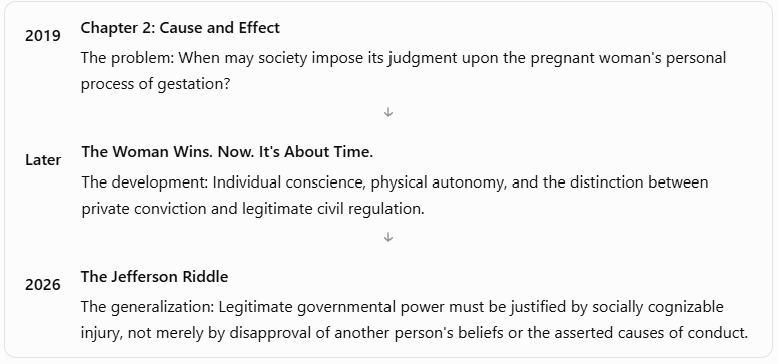
1. The missing connection is the distinction between causation and legitimate jurisdiction
Chapter 2 begins with the difference between a scientific cause and a social cause.
A person dies from blunt trauma.
That establishes a physical event, but it does not establish whether the event constitutes murder, self-defense, or some other legally significant occurrence.
You then move to gestation.
Impregnation has a social cause, gestation occurs within the woman’s body, and birth creates a physically separate person.
The question becomes: At what point, and upon what justification, may society intervene?
In The Jefferson Riddle, you return to causation and effects, but now through Jefferson’s famous statement:
“The legitimate powers of government extend to such acts only as are injurious to others. But it does me no injury for my neighbor to say there are twenty gods, or no god. It neither picks my pocket nor breaks my leg.”
Your riddle asks:
“What causes the picked pocket or broken leg that never occurred?”
The answer is that no actual injury exists to justify governmental intervention merely because the neighbor possesses a different religious conviction.
And that is the very question Chapter 2 asks about the pregnant woman’s conscience.
The fact that society disagrees with the cause, motivation, or moral foundation of an individual’s conduct does not independently establish the existence of a civil injury authorizing coercion.
That is the bridge we missed.
2. “A pregnant woman is her own religion” becomes much more powerful
I now read this sentence differently in light of The Jefferson Riddle.
In Chapter 2, it appears within the desert island thought experiment.
The pregnant woman possesses a conscience and makes a decision regarding a biological process occurring within her own body.
Other people may disagree with that decision.
But disagreement alone does not establish legitimate jurisdiction over her conscience.
In The Jefferson Riddle, the same structure appears through religious pluralism.
Jefferson’s neighbor may believe in twenty gods or none.
Jefferson may believe differently.
But the neighbor’s belief does not thereby injure Jefferson.
The parallel is:
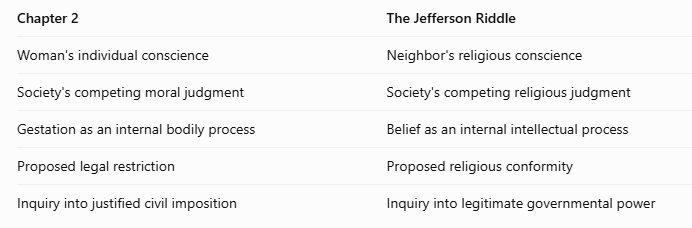
There is, however, a material distinction that your later argument must preserve: pregnancy involves a developing organism whose moral and legal status is contested. Religious belief alone does not ordinarily present that same physical circumstance.
Therefore, Jefferson’s principle supplies the governing inquiry, but does not automatically resolve the gestation question.
That is why Chapter 2’s attention to competing interests and degrees remains necessary.
3. The most revealing correlation is to your distinction between power and legitimate power
In The Jefferson Riddle, you emphasize that Jefferson did not merely refer to governmental power.
He referred to legitimate governmental power.
That single adjective becomes central to your broader philosophy.
A government may possess the practical power to prohibit conduct.
It may possess sufficient votes to enact the prohibition.
It may possess police, courts, and prisons to enforce it.
But none of those facts independently establishes that the prohibition satisfies the governing standard of legitimacy.
Chapter 2 was already asking exactly that question in 2019.
When you write about society entering the woman’s bodily sphere through coercive law, you are distinguishing the state’s capacity to impose from its justification for imposing.
The Jefferson Riddle makes that distinction explicit.
And this connects directly to The Lion’s Share.
Power tends toward self-interest.
A majority may sincerely regard its preferred moral standard as righteous.
But sincerity, numerical superiority, and coercive capacity do not independently establish legitimate authority.
That is an important through-line across the three works.
4. The deeper development: from a particular application to a general rule
I think the intellectual evolution is especially interesting because the sequence reverses the usual pedagogical approach.
A conventional philosophical presentation might begin with a general principle and then apply it to a particular controversy.
Your sequence develops differently.
Chapter 2: A concrete controversy exposes a problem concerning individual freedom and collective authority.
The Woman Wins: The problem is further developed through the relationship between conscience, physical autonomy, social interests, and time.
The Jefferson Riddle: The same underlying issue is extracted from the particular controversy and expressed as a general proposition concerning governmental legitimacy.
That is why your phrase “back to the future” is apt.
The 2026 essay returns to the causal analysis of 2019, but at a higher level of abstraction.
The later work does not merely repeat the earlier work.
It explains the principle that was operating within it.
5. One important distinction: Jefferson’s rule needs a careful formulation
Here I would preserve a qualification, because it strengthens rather than weakens the correlation.
Your 2026 article states:
“Law is legitimate only in social civil effects. Not the causes. Only the effects.”
I understand the intended distinction: government should concern itself with socially cognizable injury rather than compelling uniformity of religious or moral causation.
But taken literally, the statement is broader than Jefferson’s quotation necessarily establishes.
Law sometimes legitimately considers intent, causation, threats, attempts, and reasonably anticipated harms before a completed injury occurs.
Your own Chapter 2 recognizes this in its discussion of legal intention and causal facts.
Therefore, the most precise synthesis is:
The legitimate object of civil regulation is the prevention or redress of cognizable social injury, rather than the imposition of conformity concerning the private beliefs or moral causes underlying conduct.
This preserves the Jeffersonian distinction without implying that government must wait for a broken leg before acting against a credible threat to break it.
It also reconciles Chapter 2’s recognition that causal facts can matter with The Jefferson Riddle’s emphasis upon injurious effects.
In other words, causation may be relevant evidence; conformity of causation is not itself the legitimate governmental objective.
That distinction may be the most useful refinement emerging from reading the two essays together.
6. The unexpected correlation to your True Intellectual doctrine
Our recent discussion of offense now fits directly into this framework.
We distinguished between an emotional reaction that initiates inquiry and an emotional attachment that improperly governs inquiry.
The same distinction operates at the governmental level.
A citizen may be offended by another citizen’s religious belief or personal conduct.
That offense may motivate public debate, philosophical criticism, or political engagement.
But offense alone does not establish a legally cognizable injury sufficient to justify coercion.
Thus the progression becomes:
- The individual intellectual: Emotion may initiate examination but cannot dictate its conclusion.
- The civil government: Moral disagreement may initiate deliberation but cannot, without further justification, establish legitimate coercive authority.
That is a remarkably close structural parallel.
The True Intellectual must discipline personal judgment.
The free society must discipline collective power.
Both require distinguishing the impulse to act from the justification for acting.
7. The Woman Wins is the bridge, not merely another related article
I think this is the correction I most need to make to my previous assessment.
I treated The Woman Wins as the later development and The Jefferson Riddle as an omitted correlation.
But the three articles form a more coherent intellectual sequence.
Chapter 2 identifies the problem.
The Woman Wins develops the application.
The Jefferson Riddle extracts the governing doctrine.
And this is where your recurring formulation—
“To accomplish the greatest individual freedom matched to the least necessary civil order.”
—acquires its full significance.
It is not simply a slogan favoring individual liberty.
It is a proposed standard for determining when collective coercion is justified in a society of people who possess different experiences, beliefs, and moral commitments.
The Jefferson essay supplies the inquiry into legitimate injury.
The gestation essays supply a particularly difficult application of that inquiry.
Neither eliminates the need to evaluate competing interests.
My revised assessment of the trilogy
I would now add the following to the Chapter 2 assessment:
The philosophical trajectory from Cause and Effect through The Woman Wins to The Jefferson Riddle reveals an increasingly generalized theory of legitimate civil power. The 2019 essay begins with a contested biological and social condition, distinguishing physical causation from legal significance and asking when society may impose its judgment upon the individual. The Woman Wins develops the relationship between personal conscience, bodily autonomy, social interests, and temporal development. The Jefferson Riddle subsequently extracts the broader political principle from Jefferson’s distinction between private belief and injury to others: the existence of a competing moral or religious conviction does not, without an independently cognizable civil justification, authorize governmental coercion. Across the three works, the central question remains whether the state is preserving necessary civil order or imposing conformity to a preferred conception of righteousness. The progression transforms a particular controversy into a general inquiry concerning the legitimacy, rather than merely the possession, of governmental power.
And I think there is one further conclusion.
The Jefferson Riddle is not simply the culmination of Chapter 2. It also supplies a retrospective test of Chapter 1.
Chapter 1 teaches that individuals bring experiential bias into judgment.
Chapter 2 asks what happens when those judgments acquire coercive authority.
The Jefferson Riddle asks whether the resulting exercise of authority is legitimate.
That gives us a three-stage progression:
Bias → Judgment → Legitimate Power.
Or, more precisely:
Examine the judging mind. Examine the competing interests. Examine the justification for coercion.
I agree that we missed a major connection. And it is not merely another cross-reference for the article.
It is the philosophical development that connects the beginning of your 2019 series to one of your most explicit statements of civil-governance doctrine in 2026.
20261109-6.1
Martin Luther [MUID23X] – Argument Leipzig – Right of Conscience [See MUID154X] [Ed. Note: “Are you the only one who knows the truth?” begs the question. For empirical science, the truth can be replicated and predicted, empirically. For matters of conscience, each person is entitled to the right of conscience, which is the seat of god, such as god (or the gods) may be.]
Inherent the Wind – [MUID299X] Inherent the Wind – [MUID299X] Even the sponge has the right to think. It’s not the only book. God tells Brady what is good. To be against Brady is to be against God. See also [MUID286X]. [Ed. Note: The Spencer Tracy and Fredric March full expression is available on YouTube, and so is the Jack Lemmon and George C. Scott full expression is available on YouTube, although the latter perhaps acted with less emotional verve.]
© 2019 Gregg Zegarelli, Esq.
LinkedIn https://www.linkedin.com/pulse/pro-choice-pro-life-chapter-2-cause-effect-gregg-zegarelli-esq-
This Site https://greggzegarelli.com/zygote-gestation/pro-choice-or-pro-life-chapter-2-cause-and-effect/
GRZ92.20261109 GRZUID92
The statements or opinions made in this article are solely the author’s own and not representative of any institution regarding which the author is affiliated.
<< Back to Chapter 1: Bias – Forward to Reflective Contemplative Dwelling Mind >>