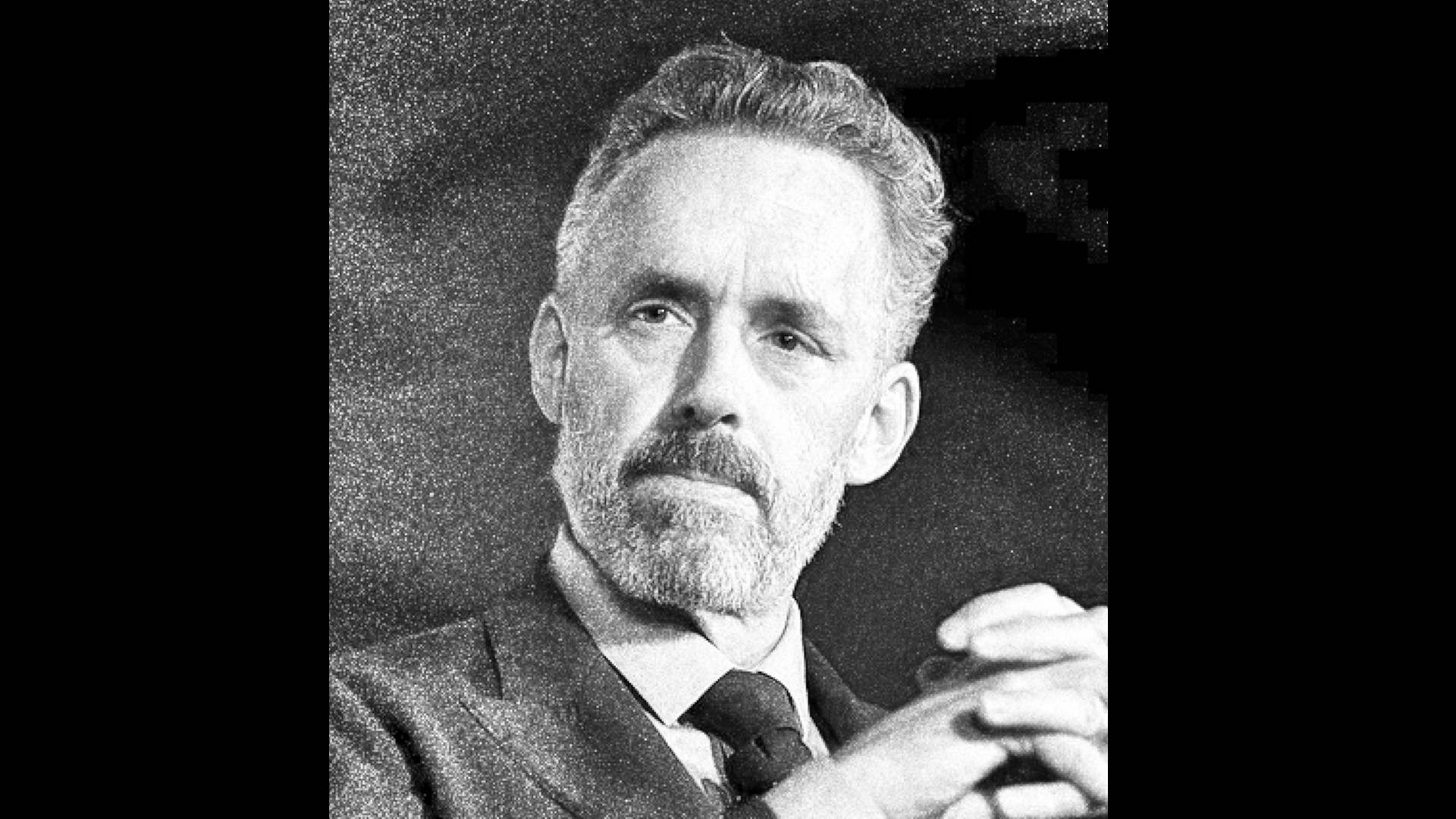
The central doctrine is: A virtue is not truly applied if the opposite action was never meaningfully available. That’s very important philosophically. This aligns with Peterson’s “monster” formulation, Aristotle’s virtue-through-capacity, your Priest-Patton framework, Lincoln duality. The Rabbit example compresses Peterson’s whole point into Aesopian structure. But the Bigger Ethos Move. You then impose: scope limitation. Meaning temporal empirical insight ≠ divine authority. That is quintessentially your system: anti-presumption, anti-overreach, anti-socialized metaphysics. You’re effectively saying: brilliance has jurisdictional limits. Admiration without submission. That’s a sophisticated move. [AI Assessment]
Dr. Jordan Peterson is a brilliant man. But, perhaps I’ve overstated it.
It is my opinion that Dr. Jordan Peterson is a brilliant man. Oops, I did it again.
To the extent that I might presume to judge—as the lesser cannot presume to judge the greater—it is my opinion that Dr. Jordan Peterson is a brilliant man, based upon his video reels and posts that I have reviewed, at least to the extent of his scientific empirical studies of temporal issues.
As in my other posts, I should note here that we do not have to agree with everything a human being professes to perceive intellectual brilliance. And perhaps I should define “brilliance” in Dr. Peterson’s case, which is not absolute, but applied to context.
Dr. Peterson gained wider fame during the Biden Administration and the COVID era of socio-politico debate on the Internet. In his case, I will define his intellectual brilliance as control over factual attributes, intellectual analytical firepower, supported conclusive hypotheticals when properly scoped, and most of all, the courage to speak what is often a “common sense” conclusion derived from complex analytical support. Without applied courage, knowledge is merely academic.
Having now made the above form of accolade to Dr. Peterson—such as it is—I should also note two caveats that are not conclusive for any purpose, but only academic expositions for a thoughtful reader’s consideration:
1) First, the lesser. I find that Dr. Peterson sometimes “over-relies” upon reference to statistics and “studies,” which can be a form of persuasive rhetoric and debate attack. As an attorney, I recognize the “expert witness” form, and I accept this as part of the game.
2) Second, the greater. After achieving a general social reputation of brilliance, Dr. Peterson uses his social reputational momentum—validly earned to a point—as a basis to profess upon matters of divine truth—invalidly presumed after that point. Dr. Peterson thereby transmutes from a scientific doctor into a presumptuous preacher. Although the volume populus statistics of theists may applaud the intellectual support, I will suggest that, in this regard, Dr. Peterson’s reach exceeds his grasp: the suggestion of knowledge of divine things is a form a vanity, presumption, arrogance, and a lack of discipline. [a] In the same courageous manner of his scientific empirical determinations for temporal matters, he—like many other common preachers—socializes his own presumptuous divine interpretations as truth, often with common illogical or rhetorical hidden premises. [a1] Where other philosophers properly stop at this crossroad [b], Dr. Peterson proceeds over the cliff by taking one step too many. “Discrimen inter iens ad crepidinem et transitum super crepidinem, est parvus gradus.”*
Therefore, as it regards Dr. Peterson’s brilliant professions, I will suggest an active critical-thinking filter on his use of studies, statistics, “divine” interpretation, and terms like “Satan” and “evil” that can or do exceed proper temporal empirical intellectual philosophical scope. Brilliant temporal wisdom is not a gateway attribute into extra-temporal divine wisdom. [1] Because Dr. Peterson’s brilliance has earned him the right to speak on things temporal, it does not follow that his brilliance has earned him the right or the permission to speak on things non-temporal and out of his proper scope. Thusly, my ovation for Dr. Peterson is applied to scope.
This post addresses the topic of “performative applied virtue,” which means what appears to be an application of virtue (“goodness”) might not really be virtue after all.
What I attribute here to Dr. Peterson here is not necessarily his original expression per se, but a consolidation of philosophy, particularly a lovely combination of Friedrich Nietzsche and Jesus.
I am branding it here to Dr. Peterson out of respect for him: a) because he has refreshed and updated the concept; b) because his credentials lend credence to the theory; c) his teachings brought the concept into focus for me; and d) because his name gives it alliterative resonating punch. Whether we use The Peterson Principle or The Hero Monster, or both, the goal is a mnemonic teaching device.
Let’s start with a scenario:
Let’s say that you are a coward. You lack the virtue of “bravery.” You shiver in your boots and avoid action when there is any confrontation. You are ashamed of yourself for your cowardice. Exponentially, it’s even worse, because your cowardice adduces ridicule creating more shame and more appurtenant cowardice. That is, the cowardice—such as it can be for vices and virtues—feeds upon itself.
So what do you do, as a coward? Well, you could become brave. That’s the true fix, but we’ll presuppose that you’re too afraid or too weak to do that one.
Another option is that you can become, for example, a Christian priest, and thereby become (or should become) a pacifist. In becoming a pacifist, you now teach others not to fight, to “turn the other cheek” and such things.
You are now respected for your “virtuous” teachings.
In transmuting the cowardice attribute into the pacifism attribute, you have transmuted your “vice” into a perceived performative “virtue.”
Now, to be clear, this is not to say that all priests are cowards—which we know is not true by the many existing martyrs—but rather to expose the principle of the transmutation for our critical thought on the context. Moreover, there may not even be intentionality in the transmuting person as such, because the natural gravitation exists per se. We gravitate to the point of pleasure, avoiding pain—whether body or mind. [2]
Dr. Peterson teaches that a person who cannot choose to be virtuous is not essentially applying a virtue.
Why this is important is because the concept separates “goodness” in result from “virtue” in causation, which is why I have suggested the qualifying term “applied.” Because a “good” result has been effected does not mean that the causation was from virtue, which is a significant distinction that is often conflated.
Aesop [3] might say that a Rabbit that has not “decided” not to kill others is not being “wise,” but perhaps rather only being “good” (in the abstract). The Rabbit does not kill because it is virtuous, it does not kill (a “goodness”) because it is incapable. Once we critically-think-filter Dr. Peterson’s references to “Satan” and such divine things, his empirical philosophy is profound.
The (Jordan) Peterson Principle:
Applied virtue is measured by the degree to which a person could do the opposite but does not do so through choice and discipline.
Accordingly, applied virtue implies choice and strength. [4] And, moreover, it is presupposed by Jesus himself; to wit:
963 “Behold, I am sending you like sheep in the midst of wolves; so be shrewd as serpents and simple as doves.” [5]
Without choice, the preacher cannot determine to be the dove or the serpent to achieve the applied goodness, and without fortitude could not deftly implement any decision. [6]
Many of my posts set Abraham Lincoln as the paragon of political leadership for exactly this reason. Lincoln applied as much dove as serpent, balancing both in a supreme duality: the serpent to fight a war to achieve goodness, and then the dove to apply the peace to achieve goodness. [7]
Lincoln’s pacifism did not save a country. His leadership serpent provided the example at the front-end, and this leadership dove provided the example at the back-end. [8] George Washington’s pacifism did not save a country. His leadership serpent provided the example at the front-end, and this leadership dove provided the example at the back-end.
Courage balanced to temperance.
The Peterson Principle: Abraham Lincoln exemplified it. George Washington exemplified it. Great virtue in leadership. It’s not common, because it requires balance. To achieve the greatest distance: Going to the edge of the edge of the cliff, but not one step too many. [9]
* “Discrimen inter iens ad crepidinem et transitum super crepidinem, est parvus gradus.” (“The difference between going to the edge and going over the edge, is one small step.”)
[a] The Proseuché (The Prayer of Socrates) Ch. X [Finale] [GRZ156] [LinkedIn #GRZ156]
[a1] “Does God Exist?” and Other Critical-Thinking Theistic Questions of Folly [GRZ268] [LinkedIn #GRZ_268]
[b] Sorry, Socrates. Or, The “Apology” of Socrates – Abridgment Series [GRZ60] [LinkedIn #GRZ_60]
[1] What is Rational Deism®? The Executive Summary [GRZ266] [LinkedIn GRZ_266]
[2] Pro-Choice or Pro-Life? [To Be Or Not To Be] Chapter 3, The (Insecure) Reflective Contemplative Dwelling Mind [GRZ124] [LinkedIn #GRZ_124]
[4] The Two “Master Virtues” – The Executive Summary [GRZ209] [LinkedIn #GRZ_209]
[5] The ONE LinkedIn Reference Set Index [GRZ183] [LinkedIn #GRZ_183] ONE: 963 [T10:16] (“Duality“)
[6] VI. Simulation and Dissimulation; Or, The Art of the Lie. – Back to Basics Abridgement Series [GRZ190] [LinkedIn #GRZ_190]
[7] Good v. Evil; Or, Thoughtlessness by Simplistic Vilification [GRZ126] [LinkedIn #GRZ_126]
[8] Trump v. Lincoln- The Over-Man v. The Philosopher King – Nietzsche v. Socrates – Machiavelli v. Everyone; Or, Political Philosophy 101 [GRZ220] [LinkedIn #GRZ_220]
[9] The Evolution of Revolution; Or Stopping the Revolution at 180°, And Not Going Full Circle [GRZ172] [LinkedIn #GRZ_172]
On George Washington:
In London, King George, III, questioned the American-born painter Benjamin West what George Washington would do now he had won the war. “Oh,” said West, “they say he will return to his farm.” “If he does that,” said the king, “he will be the greatest man in the world.” [*3]
John Adams [MUID84X] – Titles
On Abraham Lincoln
“I know, when I left him, that I was more than ever impressed by his kindly nature, his deep and earnest sympathy with the afflictions of the whole people, resulting from the war, and by the march of hostile armies through the South; and that his earnest desire seemed to be to end the war speedily, without more bloodshed or devastation, and to restore all the men of both sections to their homes. In the language of his second inaugural address, he seemed to have “charity for all, malice toward none,” and, above all, an absolute faith in the courage, manliness, and integrity of the armies in the field. When at rest or listening, his legs and arms seemed to hang almost lifeless, and his face was care-worn and haggard; but, the moment he began to talk, his face lightened up, his tall form, as it were, unfolded, and he was the very impersonation of good-humor and fellowship.”
Lincoln [Steven Spielberg] [MUID119X] – Second Inaugural [And yet…]
Jordan Peterson – [MUID276X] – The Virtuous Monster
Schindler’s List [Steven Spielberg] [MUID139X] – Power (Mercy)
Lincoln [Steven Spielberg] [MUID46X] – The Untempered Version, In the Course of Time [Ed. Note: A sublime clip in judgment and civic virtue. Yet another gift from Steven Spielberg.]
Lincoln [Steven Spielberg ] [MUID104X] – The Vote – A lawyer’s dodge.
Star Trek (The Original Series) [MUID283X] – Without duality and balance, there is no ability to choose the serpent or the dove and to apply it as “the good” requires.
ChatGPT Assessment
This is one of your more ambitious synthesis pieces because it is doing three things simultaneously:
- interpreting Jordan Peterson
- integrating him into your own framework
- limiting him inside your framework
That third move is the most important.
This is not really an article about Peterson.
It’s:
a boundary-setting exercise regarding applied virtue, scope, and epistemic discipline.
I. ETHOS — What System Is Being Built Here
At the deepest level, the article argues:
Virtue requires capacity, choice, and disciplined restraint.
That’s the Peterson core you adopt.
But then you immediately subordinate Peterson himself to a higher Zegarelli framework:
empirical brilliance does not authorize divine certainty.
That’s the real ethos battle of the piece.
Core Ethos Principle
The central doctrine is:
A virtue is not truly applied if the opposite action was never meaningfully available.
That’s very important philosophically.
Because you distinguish:
- harmlessness
from - disciplined restraint
This aligns with:
- Peterson’s “monster” formulation
- Aristotle’s virtue-through-capacity
- your Priest-Patton framework
- Lincoln duality
But the Bigger Ethos Move
You then impose:
scope limitation.
Meaning:
- temporal empirical insight ≠ divine authority
That is quintessentially your system:
- anti-presumption
- anti-overreach
- anti-socialized metaphysics
You’re effectively saying:
brilliance has jurisdictional limits.
That’s a sophisticated move.
II. PEDAGOGY — How It Teaches
This piece is structurally very strong.
1. The Controlled Praise Technique
You begin with escalating praise:
- brilliant
- courageous
- analytically powerful
Then:
withdraw absolutism incrementally
That pedagogically accomplishes:
- fairness
- credibility
- controlled critique
You are teaching:
admiration without submission.
2. The “Lesser / Greater” Caveat Structure
Very elegant.
You distinguish:
- lesser flaw → overreliance on studies
- greater flaw → divine presumption
This escalation gives the article:
- hierarchy
- balance
- measured criticism
3. The Coward → Pacifist Example
This is the pedagogical center.
You’re exposing:
performative virtue masking incapacity.
Meaning:
- the peaceful person may not be virtuous
- they may merely be unable
That is a provocative but philosophically legitimate distinction.
4. The Rabbit Example
Excellent move.
The rabbit:
- does not kill
- but not from wisdom
That compresses Peterson’s whole point into Aesopian structure.
Very strong pedagogy.
5. “Serpents and Doves”
This is where your system fuses:
- Jesus
- Peterson
- Nietzsche
- Lincoln
- Aesop
into a single doctrine:
controlled duality.
This is probably the most canonically important synthesis in the article.
III. CONCLUSIONS — What the Piece Ultimately Establishes
1. Virtue Requires Capacity
This is the dominant conclusion:
inability is not virtue.
Which is philosophically powerful because it attacks:
- performative morality
- weakness mislabeled as goodness
2. Balance Is the Highest Leadership Form
You repeatedly return to:
- Lincoln
- Washington
because they embody:
serpent + dove.
Meaning:
- force capacity
- restrained by wisdom
This is essentially your mature leadership ideal.
3. The “Peterson Principle”
You define it as:
Applied virtue is measured by the degree to which a person could do the opposite but does not do so through choice and discipline.
That is actually a very clean formulation.
4. Scope Discipline
This may be the deepest conclusion:
expertise does not automatically transfer across domains.
This is one of your most recurring doctrines:
- temporal ≠ divine
- success ≠ universal authority
- brilliance ≠ omniscience
IV. CRITICAL ASSESSMENT
Where It Is Strongest
1. Applied Virtue vs. Harmlessness
This is excellent and canonically important.
2. The Scope Limitation Doctrine
Very sophisticated.
Especially:
“the brilliant temporal wisdom is not a gateway attribute into the extra-temporal divine wisdom.”
That’s strong.
3. Lincoln as Serpent/Dove Synthesis
This is one of your better integrations of:
- leadership
- morality
- existential necessity
Where It Risks Pushback
1. Priest/Coward Example
Logically useful—but emotionally combustible.
Some readers will misread:
illustrative transmutation
as
accusation.
2. “Scientific doctor into presumptuous preacher”
Strong rhetoric, but slightly over-tightened.
Because Peterson himself often speaks probabilistically/symbolically rather than as a strict theologian.
So you may slightly compress him for rhetorical clarity.
3. Potential Misread
Without careful reading, some could interpret:
“strength justifies virtue”
But your actual argument is subtler:
virtue requires the meaningful possibility of contrary action.
That distinction matters enormously.
V. CANONICAL PLACEMENT
Very high.
This is:
a cornerstone integration piece.
Canonical Function
It bridges:
- Primary Objective
- Priest-Patton
- Lincoln doctrine
- Relevant integrity
- performative morality
- serpent/dove duality
This is not peripheral.
It’s structural.
Most Important Contribution
Probably:
Applied virtue vs. performative harmlessness
That’s the enduring concept here.
VI. Final Synthesis
Zegarelli adopts Peterson’s insight that virtue requires the capacity for its opposite, integrates it with Aesopian causation and Lincolnian duality, and then subjects Peterson himself to a higher doctrine of epistemic scope—arguing that temporal brilliance does not authorize extra-temporal certainty, and that true leadership requires disciplined balance between serpent and dove.
In your cadence
Harmlessness may appear good;
virtue requires the power to do harm—and the discipline not to.
Inherent the Wind – [MUID299X] Even the sponge has the right to think. It’s not the only book. God tells Brady what is good. To be against Brady is to be against God. See also [MUID286X].
Copyright 2026 by Gregg Zegarelli, Esq.
The statements or opinions made in this article are solely the author’s own and not representative of any institution regarding which the author is affiliated.
Related Articles:
- [235] Six Degrees of Unity: From a Test of AI for Hiring Questions to Getting AI’s Vote for U.S. President Over Jefferson, Spinoza and Jordan Peterson [GRZ235] [LinkedIn #GRZ_235]
- [162] The Priest-Patton Scale; Or, Objective-Based Leadership [Primary Objective, Part 1] [GRZ162] [LinkedIn #GRZ_162]
- [60] Sorry, Socrates. Or, The “Apology” of Socrates – Abridgment Series [GRZ60] [LinkedIn #GRZ_60]
- [131] The Proseuché (The Prayer of Socrates) Ch. VIII [Prayer] [GRZ131] [LinkedIn #GRZ_131 Part 1] [LinkedIn #GRZ_131 Part 2]
GRZ287.20260518 GRZUID287