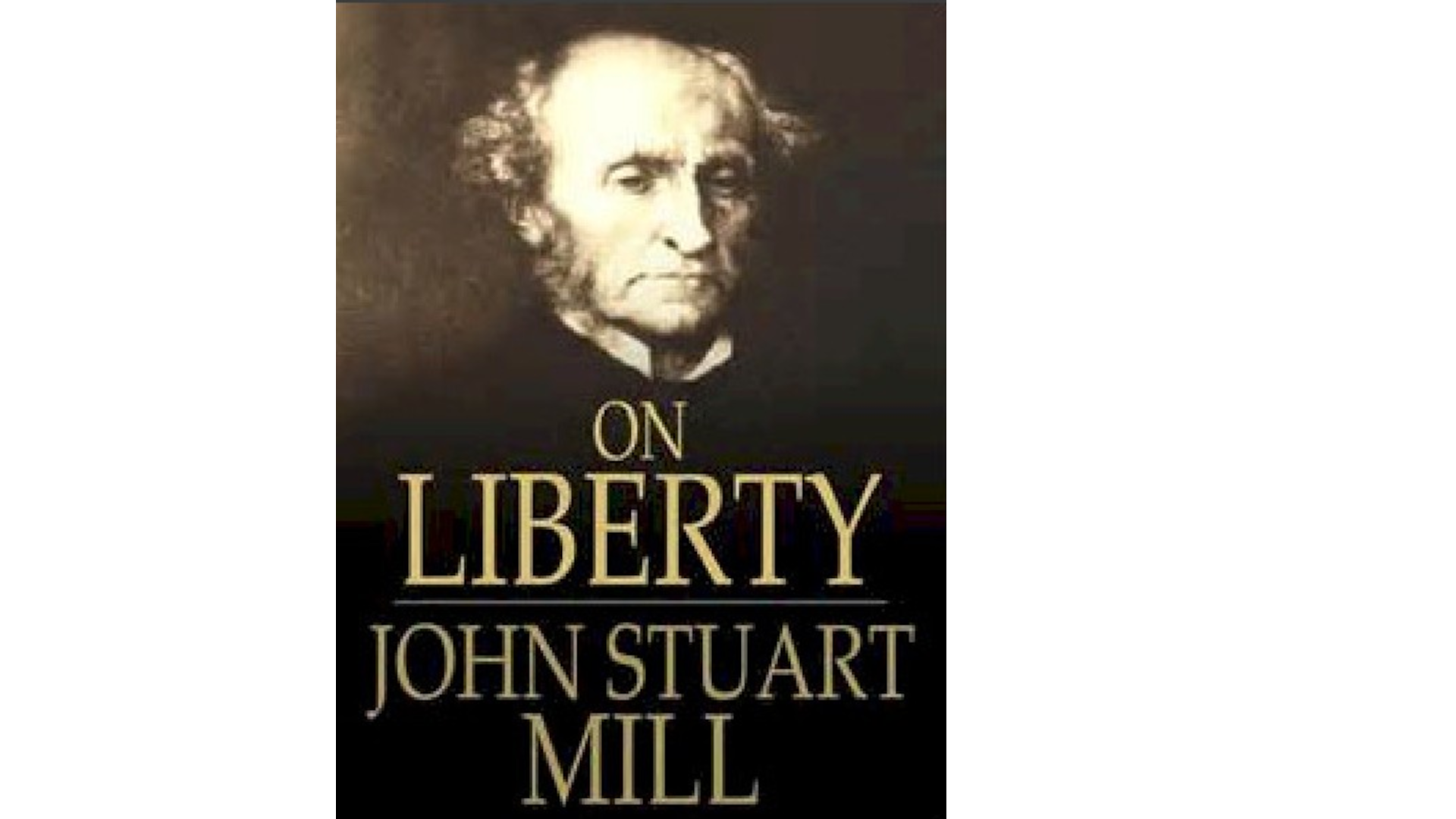
John Stuart Mill (1806 – 1873) was an English philosopher, political economist and civil servant. He has been called “the most influential English-speaking philosopher of the nineteenth century.” Following is a brief excerpt from his treatise, On Liberty.
No one can be a great thinker who does not recognize, that, as a thinker, it is his first duty to follow his intellect to whatever conclusions it may lead.
Truth gains more even by the errors of one who, with due study and preparation, thinks for himself, than by the true opinions of those who only hold them because they do not suffer themselves to think.
Not that it is solely, or chiefly, to form great thinkers, that freedom of thinking is required. On the contrary, it is as much, and even more indispensable, to enable average human beings to attain the mental stature which they are capable of.
Where there is a tacit convention that principles are not to be disputed; where the discussion of the greatest questions which can occupy humanity is considered to be closed, we cannot hope to find that generally high scale of mental activity which has made some periods of history so remarkable.
Never when controversy avoided the subjects which are large and important enough to kindle enthusiasm, was the mind of a people stirred up from its foundations, and the impulse given which raised even persons of the most ordinary intellect to something of the dignity of thinking beings.
In politics, it is almost a commonplace, that a party of order or stability, and a party of progress or reform, are both necessary elements of a healthy state of political life; until the one or the other shall have so enlarged its mental grasp as to be a party equally of order and of progress, knowing and distinguishing what is fit to be preserved from what ought to be swept away.
Each of these modes of thinking derives its utility from the deficiencies of the other; but it is in a great measure the opposition of the other that keeps each within the limits of reason and sanity.
Unless opinions favorable to democracy and to aristocracy, to property and to equality, to co-operation and to competition, to luxury and to abstinence, to sociality and individuality, to liberty and discipline, and all the other standing antagonisms of practical life, are expressed with equal freedom, and enforced and defended with equal talent and energy, there is no chance of both elements obtaining their due; one scale is sure to go up and the other down.
Truth, in the great practical concerns of life, is so much a question of the reconciling and combining of opposites, that very few have minds sufficiently capacious and impartial to make the adjustment with an approach to correctness, and it has to be made by the rough process of a struggle between combatants fighting under hostile banners.
“Truth is so much a question of the reconciling and combining of opposites, that very few have minds sufficiently capacious and impartial to make the adjustment with an approach to correctness, and it has to be made by struggle between combatants fighting under hostile banners.”
On any of the great open questions just enumerated, if either of the two opinions has a better claim than the other, not merely to be tolerated, but to be encouraged and countenanced, it is the one which happens at the particular time and place to be in a minority.
That is the opinion which, for the time being, represents the neglected interests, the side of human well-being which is in danger of obtaining less than its share.
I am aware that there is not, in this country, any intolerance of differences of opinion on most of these topics. They are adduced to show, by admitted and multiplied examples, the universality of the fact, that only through diversity of opinion is there, in the existing state of human intellect, a chance of fair-play to all sides of the truth.
When there are persons to be found, who form an exception to the apparent unanimity of the world on any subject, even if the world is in the right, it is always probable that dissentients have something worth hearing to say for themselves, and that truth would lose something by their silence.
“When there are persons to be found, who form an exception to the apparent unanimity of the world on any subject, even if the world is in the right, it is always probable that dissentients have something worth hearing to say for themselves, and that truth would lose something by their silence.”
Family Guy [MUID5X] – The Whom Owl
Game of Thrones [MUID42X] – Kill the Boy [Ed. Note: Not to be controlled by “Likes,” but to do what we believe is right. As stated in many posts, “Time will get its day.”]
Apple Advertisement (Jobs Version) [MUID125X] – The Crazy Ones [Ed. Note: Often overlooked, the Apple “Think Different” advertisement is a contradiction to proper grammar. The verb requires an adverb as the qualifier. It should be “Think Differently,” so the advertisement itself exemplifies its own message.]
Marco Polo [MUID78X] – Certainty of Self [Ed. Note: This is the antithesis to jumping on or joining a bandwagon. Certainty of self keeps a thing true to itself without absorbing something else, being a failure of the discipline of integrity. (See MUID109X])
The Fountainhead [MUID153X] – Public Opinion [Ed. Note: “He’s too good,” meaning that society accepts good because it’s average, but “too good” is to say that something is excellent and beyond the average “good.” The implication is that society will not allow something excellent (different by genius self-definition) to survive, because it extracts human fear, jealousy of supplantation, and envy. In short, excellence is a threat. Moreover, the average does not have the integrity and discipline to self-judge by its insecurity of self and therefore seeks external standards, “When I want my opinion, I’ll ask you for it.” Francon (woman) saying “I won’t defend it” is because the subject that self-defines by its own excellence does not need the assistance of an external defense. The backstory for this Ayn Rand masterpiece is that Francon loves human beings of genius, knows that society will tend to destroy genius by the law of safe averages, knows that what she loves will therefore be at risk or be destroyed, and therefore tries to refuse to succumb to the control and pain of falling in love with a thing tending to be destroyed for that reason, but unfortunately for her, she cannot help but to love the thing, because it’s a genius, and her nature is to love geniuses.] See also, Mike Wallace Interview Ayn Rand [MUID228X]
Martin Luther [MUID23X] – Argument Leipzig – Right of Conscience [See MUID154X] [Ed. Note: “Are you the only one who knows the truth?” begs the question. For empirical science, the truth can be replicated and predicted, empirically. For matters of conscience, each person is entitled to the right of conscience, which is the seat of god, such as god (or the gods) may be.]
“The test of a first-rate intelligence is the ability to hold two opposed ideas in the mind at the same time, and still retain the ability to function.” F. Scott Fitzgerald (The Great Gadsby)
© 2016 Gregg Zegarelli, Esq.
LinkedIn https://www.linkedin.com/pulse/john-stuart-mill-thinking-opinions-gregg-zegarelli-esq-
Related Articles:
- [47] John Stuart Mill – Leadership and Being Unique from the Crowd [GRZ47] [LinkedIn #GRZ_47]
- [61] Freedom of Religion, by Thomas Jefferson (Notes on the State of Virginia) – Abridgment Series [GRZ61] [LinkedIn #GRZ_61]
- [82] Branding America – In God We Trust. Or, Adams, Franklin, Jefferson and Washington Debate the American Slogan – Stand for America® [GRZ82] [LinkedIn #GRZ_82]
- [78] All Men Are Not Created Equal, or Why Thomas Jefferson Got it Wrong – Stand for America® [GRZ78] [LinkedIn #GRZ_78]
- [36] The Insecure Human Being – The Business of Aesop™ No. 51 – A Fox Without a Tail [GRZ36X] [LinkedIn #GRZ_36]
- [30] Give Me Liberty or Give Me Death! – Abridgment Series [GRZ30X] [LinkedIn #GRZ_30]
- [84] The Google Privacy Case – 10 Year Anniversary – Business of Aesop™ No. 101 – The Porcupine and the Cave [GRZ84] [LinkedIn #GRZ_84]
- [85] Benjamin Franklin’s Autobiography – The 13 Virtues – Abridgment Series [GRZ85] [LinkedIn #GRZ_85]
- [32] When Was America Great? – Stand for America® [GRZ32] [LinkedIn #GRZ_32]
- [31] The Declaration of Independence – Abridgment Series [GRZ31X] [LinkedIn #GRZ_31X]
- [75] John Adams, Thoughts on Government – Abridgment Series [GRZ75] [LinkedIn #GRZ_75]
GRZ46.20250227 GRZUID46
<< Back to prior Abridgment Series [#GRZ_31] – Forward to next Abridgment Series [#GRZ_47] >>