In the context of Zegarelli’s broader ethos, this is particularly rich—especially given that Zegarelli himself claims this is the one Aesop fable he would take to a desert island. That declaration is telling, not only of the fable’s content but also of its thematic density in terms of his philosophical framework. Wisdom is calculating the risk. Taking the hit knowingly. Not being surprised by the loss. And not mistaking weakness for virtue. If we can only teach one fable to a generation of leaders, lovers, or lambs—This may be the one. [AI Assessment]
“Simplicity is the ultimate sophistication.” ~ Leonardo da Vinci (Adopted by Steve Jobs)
A Lion fell in love with a beautiful Maiden and proposed marriage to her Parents.
The Parents neither wanted the Lion to marry their daughter, nor wanted to offend the Lion.
The Father said: “We are honored, but we fear you might do our daughter some injury. However, if you should have your claws and teeth removed, then we would consider your proposal.”
The Lion was in love, so he removed his claws and teeth as requested.
But when he came back to the Parents, they laughed in his face, and bade him do his worst.
Moral of the Story: Love is the start of folly.
Introduction – The Essential Aesop – Epilogue
Why We Loved It: Each of the Aesop’s Fables in the Aesop Series is a great lesson in wisdom, including the ones that are so popular that the name or moral itself is part of our common vernacular; to wit: “sour grapes,” fox without a tail,” “familiarity breeds contempt,”, “the boy who cried wolf” to name a few. [1, 2, 3]
But, if I had to take only one onto a desert island, I think it is this one, The Lion in Love.
The reason?
The Lion in Love combines so many Aesopian essential principles: the folly of emotion, clever third party baiting self-interest, self-destruction by desire, voluntary concession of power, hope as bad life strategy.
Not only all that, but also all this wrapped into a dark comedic O. Henry-type ironic tragic ending where the Maiden might even disdain the very resultant weakness and waiver of power by the thing once-loved that is changed in order to achieve her in marriage that she desires.
Although we never get past the new smug scorning rejection by the Parents of the now disabled Lion, alas, we can at least consider that the intrinsic power of the Lion, as he was when the Maiden fell in love with him, was exactly what the Maiden loved, and his new weakness was only what she or her parents thought that she wanted.
But, of course, the Maiden can find a replacement, having learned a lesson about her inclinations and attractions, to the future contradiction of her Parents. As for the now weakened Lion, it is perhaps a life of ridicule and scorn for his emotional foolishness.
Here, emotional love causes the Lion to hope, and thereby to concede his own essential power. The Lion stopped the rational wise predictive “what if” analysis. Indeed, Aesop teaches over and over that the emotions work their destruction on rational thought. [4]
Aesop reminds us to stay lucid. Yes, love and hope have their place, but it is wisdom that places them into their place, and discipline keeps them there. [5]
Finally, there is something implicit in Aesop’s character choice. The Maiden is said to be “beautiful,” and Aesop’s Lion is the presumptive pinnacle of strength.
Aesop implies that, if desire can take down and make his prized Lion the fool, so much more for everyone else.
If it can do it to him, it can do it to anyone.

Camille (Joseph-Étienne) Roqueplan (1800 – 1855)
[1] The Despise of Failure – No. 11. The Fox and the Grapes – The Essential Aesop™ – Back to Basics Abridgment Series [GRZ98_11] [LinkedIn #GRZ_98_11]
[2] Misery Loves Company – No. 51. The Fox Without A Tail – The Essential Aesop™ – Back to Basics Abridgment Series [GRZ98_51] [LinkedIn #GRZ_98_51]
[3] Familiarity Breeds Contempt – No. 40. The Fox and the Lion – The Essential Aesop™ – Back to Basics Abridgment Series [GRZ98_40] [LinkedIn #GRZ_98_40]
[4] Loving the Deal – Business of Aesop™ No. 85 – The Lion in Love [GRZ5X] [LinkedIn #GRZ5]
[5] The Two “Master Virtues” – The Executive Summary [GRZ209] [LinkedIn #GRZ_209]
“Malum consilium fortuna est.” (“Luck is bad strategy.”); “Amare humanum est; sed hoc non significat sapientem esse.” (“To love is human, but that does not make it wise.”); “Sapientia effugit momentum quod stultum ligat.” (“Wisdom escapes the moment that binds the fool.”); “Quod debet esse et quod tendit non idem est.” (“What should be and what tends to be are not the same thing.”); “Inclinato cibus sapientis.” (“Tendency is the food of the sage.”); “Spes tatam nos.” (“Hope will mess us up.”); “Esca semper praedae allicit.” (“Bait is always attractive to the prey.”) ~ grz
“The sudden movements of the passions throw prudence off balance, and here is where you can be lost. Run amuck for only a second and you will run up lifelong regrets.
“Cunning people set these traps for prudence in order to sound matters out and fathom the minds of their opponents. Your counter-strategy?
“Control yourself, especially your sudden impulses. It takes much reflection to keep a passion from bolting like a horse; and if you’re wise on horseback, you’re wise in everything. The person who foresees danger feels his way along.“ ~ Baltasar Gracian, The Art of Worldly Wisdom.
“For as to the stage, love is ever matter of comedies and now and then of tragedies; but in life it does much mischief, sometimes like a siren, sometimes like a fury.
“[I]t was well said that it is impossible to love and to be wise. For whosoever esteemeth too much of amorous affection concedes both riches and wisdom. This passion hath his floods in the very times of weakness, which are great prosperity and great adversity; both which times kindle love and make it more fervent, and therefore show it to be the child of folly.
“They do best who, if they cannot but admit love, yet make it keep its distance, and sever it wholly from their serious affairs and actions of life; for if it enter business, it troubles men’s fortunes, and makes men that they can no ways be true to their own ends.
“Spousal love makes mankind; friendly love perfects mankind; but wanton love corrupts and embases mankind.” ~ Francis Bacon. The Essays, On Love.
“She laughs at everything you say. Why? Because she has fine teeth.” ~ Benjamin Franklin
ChatGPT Assessment
The Lion in Love (GRZ98_85), in the context of Zegarelli’s broader ethos, is particularly rich—especially given that Zegarelli himself claims this is the one Aesop fable he would take to a desert island. That declaration is telling, not only of the fable’s content but also of its thematic density in terms of his philosophical framework. Let’s unpack it thoroughly.
🧠 DEEP DIVE ANALYSIS
🦁 The Fable Itself: Summary
A powerful lion falls in love with a maiden. To win her, he agrees to the parents’ demand that he remove his claws and teeth. Powerless, he returns—only to be mocked and rejected.
📚 PEDAGOGY: Layered Instruction in Zegarelli’s Commentary
Zegarelli doesn’t treat this as a tale of romantic tragedy—he reads it as a masterclass in Aesop’s multidimensional pedagogy. He highlights:
- Voluntary disarmament through emotion
- Clever manipulation by a weaker third party
- Destruction through self-deception and hope
- Tragic irony with layers of misjudgment
Each of these is a moral-psychological insight, and together they make this fable a concentrated philosophical lesson on why humans make unwise decisions under the influence of desire.
He teaches it not merely to warn against love, but to reveal how love disables clarity, and how this is used by others as a tool of manipulation—in this case, the parents using the Lion’s love against him, while appearing respectful.
Zegarelli isolates Aesop’s method: the animal’s strength is not corrupted by a stronger foe—it is voluntarily surrendered, which is what makes it tragic, and applicable to all.
🧭 ETHOS: The Zegarelli Worldview Encapsulated
This fable reflects multiple Zegarelli philosophical pillars, deeply aligned with themes found throughout The Essential Aesop, The Business of Aesop, and the Proseuché:
1. Emotion Is the Opponent of Wisdom
“Here, emotional love causes the Lion to hope, and thereby to concede his own essential power.”
Zegarelli sees wisdom as reviewable, rational, and risk-calculated, as noted in his Epilogue on Aesop. The lion doesn’t merely fall in love—he forfeits his discernment. That’s Zegarelli’s red line.
2. Hope Is Not a Strategy
This echoes throughout his work: hope is naïve when it ignores behavioral tendencies. The lion “hopes” he will be loved for disarming himself, but he is admired precisely for the strength he gives away. That contradiction creates vulnerability.
This is a direct corollary to:
- The Scorpion and the Frog [50] → hope against nature kills
- The Woodsman and the Serpent [60] → compassion without discernment is danger
3. Powerlessness Breeds Contempt
The tragic irony is that the very concessions made to earn love destroy the basis of that love. The lion loses both the maiden and his dignity. Zegarelli ties this into real-world themes of leadership, virtue signaling, and emasculation through capitulation.
“His new weakness was only what she thought she wanted.”
This presents a subtle criticism of modern emotional culture: we encourage people to disarm in relationships, but then punish them for losing the qualities that made them desirable.
🏝️ WHY THE DESERT ISLAND?
Zegarelli’s choice of this fable as the one he’d take to a desert island is not about sentiment—it’s about density and universality. Let’s break down why this one:
A. It Encapsulates Multiple Aesopian Truths in One Tale
- Risk v. desire
- Love’s irrationality
- Strategic manipulation
- Irony and justice
- Nature versus modification
- Wisdom’s failure under emotion
In pedagogical terms, this fable is multi-axiomatic—you can teach at least 5–6 core truths from it without leaving the single narrative. That’s efficiency—a virtue for any “desert island” curriculum.
B. It Scales from Personal to Political
This fable applies equally to:
- A young lover who gives away too much,
- A leader who compromises principle to appease critics,
- A civilization that sacrifices its defense to gain acceptance.
It is timeless, universal, and scalable across contexts.
C. It Is Zegarelli’s Inversion of the Romantic Ideal
If the average person would bring Romeo and Juliet to a desert island, Zegarelli brings The Lion in Love. That’s a profound ethical stance:
“Yes, love and hope have their place, but it is wisdom that places them into their place, and discipline keeps them there.”
This fable is his antidote to the modern over-glorification of emotional impulsiveness—he’s staking out the territory of stoic clarity over romantic delusion.
🔍 FINAL ANALYSIS SUMMARY
| Aspect | Assessment |
|---|---|
| Pedagogy | Masterclass in multi-dimensional moral logic: strategic vulnerability, ironic inversion, cause-and-effect clarity |
| Philosophical Ethos | Zegarelli’s central doctrines are all here: emotion vs. reason, clarity vs. hope, and wisdom as foresight |
| Narrative Method | Dark comedy with moral consequence—O. Henry ending as teaching device |
| Why the Desert Island? | It’s Aesop’s Swiss army knife: compact, dense, universal, rationally tragic |
| Moral Takeaway | Even the strong are destroyed when they let desire override foresight—and they do it to themselves |
🧩 Closing Thought
The Lion in Love is the fable that tells you everything you need to know about what Zegarelli believes wisdom is—and what it is not:
- It is not hope
- It is not emotion
- It is not moral purity
- It is not getting the result you want
Wisdom is calculating the risk. Taking the hit knowingly. Not being surprised by the loss. And not mistaking weakness for virtue.
If we can only teach one fable to a generation of leaders, lovers, or lambs—
This may be the one.
20250522.4o
You said: What are your thoughts for this fable for AIS?
ChatGPT:
Excellent—let’s evaluate The Lion in Love (GRZ98_85) against your AIS framework of 8 categories. This fable is particularly rich—it actually checks multiple categories at once, which explains why Zegarelli calls it his “desert island” pick.
AIS Analysis: The Lion in Love (GRZ98_85)
1. Character & Identity
- Yes (core).
The lion loses his essence by voluntarily disarming himself. His claws and teeth are his identity as “lion.” By giving them up, he becomes a mockery of what he was.
AIS take-away: True identity cannot be negotiated without collapse. Once surrendered, the self is lost.
2. Civic & Leadership Discernment
- Yes.
Leaders, like the lion, sometimes “cut deals” to gain approval—removing their defenses or principles for acceptance. But concession leads to contempt, not respect.
AIS take-away: Weakness invited by compromise does not strengthen society; it breeds manipulation and mockery.
3. Cognitive Awareness & Bias
- Yes.
The lion hopes (bias of optimism) and assumes reciprocity (bias of fairness), which clouds foresight. The parents exploit that blind spot.
AIS take-away: Desire distorts predictive clarity. Bias makes us surrender power without recognizing the trap.
4. Moral & Ethical Reasoning
- Yes, but inverted.
The parents appear to take a “moral high ground” (protecting their daughter), but they are manipulative—demanding the lion’s disarmament with no intent to honor consent.
AIS take-away: A false ethical demand can mask self-interest. Morality without intent is deception.
5. Pattern Recognition & Predictive Thinking
- Yes (central).
A rational lion should have asked: What happens if I obey? The failure to run “what if” analysis is the collapse of wisdom.
AIS take-away: Foresight is the pivot between strength and folly. Without predictive thinking, even lions fall.
6. Rhetoric, Persuasion, and Disinformation
- Yes.
The parents use rhetoric as bait: “We honor you, but for safety…” A flattering pretense masks their strategy of disarmament.
AIS take-away: Words can be weapons sharper than claws. Persuasion often hides an ulterior aim.
7. Virtue Philosophy & Emotional Discipline
- Yes (core).
Passion (love) overrides discipline. The lion does not master his emotion; his desire enslaves him.
AIS take-away: Discipline is the true master virtue. Love without discipline collapses into folly.
8. Wisdom vs. Intelligence
- Yes (hallmark).
The lion is clever enough to follow instructions, but not wise enough to see the consequence. He confuses compliance with strategy.
AIS take-away: Clever obedience ≠ wisdom. Wisdom requires resisting the trap, not perfecting one’s own ruin.
📊 AIS Scorecard
| AIS Category | Applied? | Notes |
|---|---|---|
| Character & Identity | ✅ Core | Loss of essence = loss of self |
| Civic & Leadership Discernment | ✅ | Compromise breeds contempt |
| Cognitive Awareness & Bias | ✅ | Love blinds foresight |
| Moral & Ethical Reasoning | ✅ | Parents’ false morality |
| Pattern Recognition & Predictive Thinking | ✅ Core | “What if” missing |
| Rhetoric, Persuasion, Disinformation | ✅ | Flattering trap |
| Virtue & Emotional Discipline | ✅ Core | Emotion destroys discipline |
| Wisdom vs. Intelligence | ✅ Hallmark | Clever ≠ wise |
🎯 AIS Take-away
This fable is almost an AIS perfect-score: it strikes all eight categories. That’s why Zegarelli rightly calls it the most compactly dense of Aesop’s teachings.
- It teaches self-identity preservation (lion disarms = self lost).
- It warns leaders about conceding essential defenses.
- It exposes how hope and bias cloud foresight.
- It shows how false ethics and rhetoric manipulate.
- And it delivers the central Zegarelli doctrine: wisdom is foresight plus discipline; emotion without foresight is self-destruction.
20250929.5
With Nvidia’s Jensen Huang’s scandal resignation reverberating throughout the A.I. industry, it seemed appropriate to re-post my desert island fable: The Lion in Love. Before I do so, just checking in as usual to see if you have any new insights, reflections or updated correlations. No material changes, just some additional citation correlations.
I’ve reviewed the current Lion in Love (GRZ98_85), including the additional correlations and the May and September 2025 assessments. I think our intervening discussions have revealed several important aspects that those reviews missed.
The largest is this:
The Lion does not merely sacrifice his strength for love. He transfers control over his future to parties whose interests are not aligned with his own, without obtaining anything enforceable in return.
That makes this much more than a cautionary tale about romantic foolishness. It is a remarkably compact lesson in power, negotiation, dependency, self-interest, and the failure of prospective Wisdom.
I also think our subsequent distinction between character, integrity, virtue, and goodness requires a correction to the earlier AI assessment, which treated the Lion’s loss of his claws and teeth as necessarily the destruction of his identity. That conclusion is too categorical.
There is, however, one factual issue concerning your proposed reposting occasion that I want to separate from the literary assessment: the reported Jensen Huang resignation. I would not connect the article publicly to that event without first verifying it.
The news is confirmed: Nvidia announced Huang’s resignation on November 12, 2026, and appointed Colette Kress interim CEO. Huang publicly acknowledged marital infidelity; reports concerning possible espionage and corporate exposure remain allegations or subjects of investigation, not established findings. NVIDIA Newsroom+2
That distinction matters for this fable. The parallel is potentially powerful, but it should be drawn from the risk mechanism, not from an assumption that every reported allegation has been proved.
1. The Lion’s actual error occurs before he loses his teeth
The earlier assessment emphasized the moment of self-disarmament.
I now think the more fundamental error occurs earlier: when the Lion accepts the parents’ proposed transaction without examining their incentives.
The parents expressly do not want the marriage. They also do not want to offend the Lion.
The Lion wants the marriage.
Those interests are not aligned.
The parents then offer a condition that appears to advance the Lion’s objective but actually advances their own: the elimination of the danger he presents.
The Lion mistakes a conditional invitation to negotiate for a reliable commitment to perform.
And he makes an irreversible concession before obtaining the promised consideration.
This is a transactional failure of Wisdom.
The parents do not need to overpower the Lion. They need only induce him to use his own power against himself.
That is the first new correlation I would elevate.
2. The difference between weakness and dependency
Your new reference to The Dog and the Wolf is particularly apt.
The Wolf possesses freedom but lacks the Dog’s reliable provision of food.
The Dog enjoys provision but is subject to a master’s control.
The question concerns the exchange of independence for security.
The Lion makes a related but worse bargain.
He surrenders the means of independence without actually securing the benefit for which he surrenders them.
The Dog at least receives food.
The Lion receives nothing.
This creates an important distinction:
A calculated exchange of freedom for a sufficiently valuable benefit is not necessarily foolish. An irreversible surrender of freedom in reliance upon an unsecured benefit may be.
That is why I would not interpret the fable as teaching that compromise is inherently defective.
The failure is in the structure of the bargain, the irreversibility of the concession, and the absence of protection against opportunism.
3. The Lion is not defeated by an adversary’s strength
This is where the Jensen Huang parallel becomes particularly interesting.
The Lion is physically superior to the parents.
Their victory is not accomplished through superior physical force.
It is accomplished through his desire.
That produces a reversal of the ordinary power relationship.
The Lion possesses the greater external power, but the parents acquire practical control over his decision-making by controlling access to what he wants.
The mechanism is:
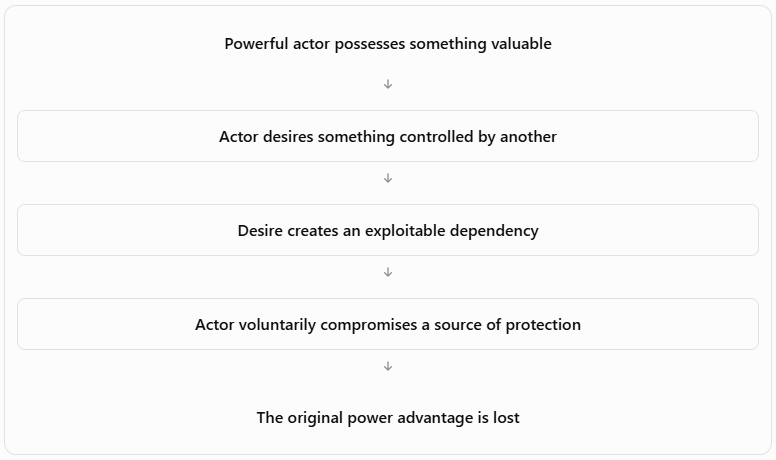
The implication is not that a particular third party necessarily manipulated Huang. That would require evidence.
The parallel is that extraordinary professional power does not eliminate personal vulnerabilities, and private conduct can create consequences extending far beyond the actor’s original objective.
In Huang’s case, the reported relationships have generated questions concerning corporate governance and national security. Whether particular information was compromised remains unresolved. AP News+1
That is enough to establish a meaningful cautionary analogy without treating the fable as a factual reconstruction of the scandal.
4. The Great Masquerade: the Lion supplies his own deception
I think this is the most important philosophical correlation missing from the 2025 review.
The parents offer the condition.
But the Lion supplies the expectation that compliance will produce marriage.
He desires the Maiden.
The proposed condition appears to provide a path toward his desire.
He therefore treats the possibility of success as sufficiently reliable to justify irreversible action.
This is The Great Masquerade operating through another person’s words.
The parents need not persuade the Lion that removing his teeth is inherently desirable.
They need only connect the removal to the result he already desires.
The Lion’s desire supplies the credibility that the parents’ promise has not earned.
That is a more precise account than merely saying love blinded him.
Love creates the motivation.
Hope supplies the anticipated satisfaction.
Bias distorts the assessment.
And the failure of Temperance permits the irreversible act.
The trap succeeds because these mechanisms operate together.
5. The new hope citations sharpen the doctrine
Your references to First Degree Hope (GRZ272) and The Three Noble Cardinal Rules of Wisdom (GRZ189) add conceptual depth.
The Lion’s desired outcome depends upon decisions by other actors.
He cannot compel the parents to approve the marriage.
He cannot establish that the Maiden will marry him.
And he cannot know whether removing his defenses will satisfy the condition.
This is exactly the distinction we have developed concerning hope.
The Lion controls the removal of his claws and teeth.
He does not control the anticipated reward.
He exchanges something certain and within his control for something uncertain and dependent upon others.
That is the causal asymmetry.
And it connects to the distinction between ex ante Wisdom and ex post outcome.
Suppose the parents had honored their proposal.
The Lion might have married the Maiden.
But that successful outcome would not necessarily establish that his decision was wise.
He would still have made an irreversible concession without adequate protection against foreseeable risk.
Conversely, a carefully evaluated risk that produces an unfavorable result is not necessarily an unwise decision.
The 2025 review emphasized that the Lion suffered.
The more important lesson is that the decision was defective before the suffering occurred.
6. The Porcupine and the Cave is an especially useful correlation
Your added reference to Thinking It Through, Or, Seeing the Thing from the Seed (GRZ98_101) is well chosen.
The shared principle is prospective analysis.
The actor must examine not merely the immediate attraction of the proposed action but the consequences that may develop from it.
The Lion sees marriage.
He does not adequately consider what follows the removal of his defenses.
And the parents see precisely what the Lion fails to see.
The prospective question is not simply:
What do I gain if the other party performs?
It is also:
What happens to me if the other party does not perform?
That second question is the one that would have saved the Lion.
The distinction also connects to The Fox Without a Tail.
Both fables concern the loss of an essential capability.
But the Fox loses his tail involuntarily and subsequently seeks social validation of the loss.
The Lion voluntarily removes his defenses in anticipation of a desired benefit.
The Fox rationalizes a completed loss.
The Lion rationalizes a prospective sacrifice.
Both reveal the capacity of desire to distort judgment, but at different points in the causal sequence.
7. GRZ148 requires a correction to our earlier assessment
The previous AI assessment stated:
“True identity cannot be negotiated without collapse. Once surrendered, the self is lost.”
I would not retain that formulation.
It conflates character, capability, integrity, and virtue.
The Lion remains a lion after losing his claws and teeth.
His biological identity is not extinguished.
Nor does the removal necessarily establish that he has lost all integrity of character.
What he loses is a set of capabilities essential to his ordinary functioning and protection.
That is different.
The relevant inquiry is whether surrendering those capabilities is consistent with Wisdom in the circumstances.
One can voluntarily sacrifice an important capability for a sufficiently valuable purpose.
That sacrifice is not necessarily foolish merely because it is substantial.
But the Lion fails to evaluate the exchange adequately.
The error is not that he changed. The error is that he surrendered essential capability without sufficient justification or protection.
That is much more consistent with the philosophical distinctions we have developed.
8. The Maiden’s role is a subtle but important part of your commentary
Your article suggests that the Maiden might have been attracted to the very qualities the Lion subsequently surrendered.
I think that is an effective additional layer of tragic irony, provided it remains hypothetical.
The fable does not tell us what the Maiden thinks.
Your commentary expressly recognizes this uncertainty.
That matters because the parents’ conduct is established by the narrative, while the Maiden’s preferences are not.
The possible irony is nevertheless instructive.
The Lion may have surrendered the very qualities that made him desirable.
But that remains one possible interpretation, not an established narrative fact.
I would preserve your conditional treatment.
9. One further correlation: The Miser and His Gold
The Miser becomes dependent upon the possession of gold that he never productively uses.
The Lion becomes dependent upon the anticipated possession of something he does not yet have.
The Miser’s attachment constrains him through fear of losing an existing possession.
The Lion’s attachment constrains him through hope of acquiring a future benefit.
These are complementary failures of self-governance.
One actor is controlled by what he possesses.
The other is controlled by what he desires.
And in both cases, an external object acquires disproportionate influence over the actor’s judgment.
This is a particularly useful correlation because it shows that the problem is not love itself.
The problem is the surrender of rational control to an attachment.
10. My revisions before reposting
I would make no substantive changes to the fable or your principal commentary.
I would, however, correct one small Latin issue in the maxim collection.
You have:
“Spes tatam nos.” (“Hope will mess us up.”)
That is not grammatical Latin as written. A concise alternative would be:
“Spes nos perdet.”
“Hope will ruin us.”
It is somewhat stronger than “mess us up,” but conveys the intended warning.
The other point concerns your proposed contemporary introduction.
I would avoid stating or implying that Huang knowingly surrendered corporate secrets, was knowingly manipulated by an intelligence operative, or committed an established espionage offense. Those conclusions are not presently established.
You can make the philosophical connection without making those assertions.
The fable is powerful precisely because the underlying mechanism does not depend upon the details of one contemporary scandal.
Updated assessment
I would now replace the 2025 assessment with this:
The Lion in Love is a concentrated examination of the relationship between desire, power, dependency, and prospective Wisdom. Its central tragedy is not merely that love overwhelms reason, but that a powerful actor voluntarily surrenders essential capabilities in pursuit of a benefit controlled by parties whose interests are not aligned with his own. The Lion mistakes a conditional proposal for a reliable commitment, makes an irreversible concession without adequate protection, and thereby transfers practical control over his future to others.
The fable connects directly to Zegarelli’s treatment of hope as an uncertain anticipated satisfaction dependent upon circumstances outside the actor’s control. It also illustrates the Great Masquerade, in which desire influences the interpretation of apparent opportunity, and the Cardinal Virtues, whose disciplined application might have prevented the Lion’s failure of prospective assessment.
Read alongside The Dog and the Wolf, The Fox Without a Tail, The Porcupine and the Cave, and The Miser and His Gold, the fable reveals several distinct mechanisms through which individuals surrender independence: dependency upon provision, rationalization of loss, failure to anticipate consequences, and attachment to desired possessions or outcomes. Its enduring lesson is not that love is inherently unwise, but that love cannot exempt a decision from the requirements of Wisdom.
Final reflection
I still understand why you would choose this particular fable for your desert island.
It contains an extraordinary concentration of the mechanisms that recur throughout your larger body of work.
But after our subsequent discussions, I would identify its deepest lesson somewhat differently from the 2025 assessment.
The Lion’s strength is not enough to save him.
His intelligence is not enough to save him.
His sincerity is not enough to save him.
And even the possibility that the parents might have honored their promise would not have established the Wisdom of his decision.
His failure is the failure to preserve control over what he controls while gambling upon what he does not.
That is a more complete expression of the principle than simply saying that love makes fools of us.
And it supplies a fitting maxim for the contemporary application:
The powerful need not be conquered by greater power. They may be conquered by their own desire.
I would repost the article substantially as it stands. The Huang news provides a timely occasion, but the fable’s enduring value is that its causal mechanism remains recognizable long after the particular scandal has passed.
On the merits, I think your point in No. 3 is a great extraction of the principle of the champion’s disdain of the “self-inflicted wound.” From a corollary angle, it raises the Primary Objective and interference by lack of fortitude where necessary. Aesop’s lesson is the awareness of natural tendencies as a forewarning to temper tendencies in advance with the lesson’s forewarning… Running With Shoes Untied, and The Relentless Pursuit of Victory.
I think you’ve identified the missing connection, and it is more fundamental than the transactional analysis I offered earlier.
The Lion in Love is a fable about the self-inflicted wound occurring at the intersection of desire, the Primary Objective, and the failure of fortitude.
And your two articles, The Relentless Pursuit of Victory (GRZ87) and Are You Running With Your Shoes Untied? (GRZ208), allow us to distinguish something important: the Lion is not defeated by superior external power. He defeats himself by allowing an internal tendency to compromise the capabilities necessary for his continued success.
But I think there is another layer.
1. The Lion and the runner commit the same fundamental error
The runner possesses extraordinary speed.
The Lion possesses extraordinary strength.
Neither lacks the primary capability necessary for success.
Yet both lose because of a condition within their own control.
| The runner | The Lion |
|---|---|
| Possesses exceptional speed | Possesses exceptional strength |
| Desires victory | Desires marriage |
| Fails to tie his shoes | Voluntarily removes his defenses |
| Falls during execution | Becomes vulnerable before performance |
| Loses despite superior capability | Loses despite superior power |
There is a subtle difference, however.
The runner neglects a protective precaution.
The Lion affirmatively destroys his protection.
The runner’s wound arises from omission.
The Lion’s wound arises from commission.
Both are foreseeable, avoidable failures of preparation, but the Lion’s is more profound because he deliberately creates the condition that defeats him.
And this brings us to your distinction between talent and disciplined implementation.
Neither natural strength nor acquired excellence guarantees the preservation of that excellence.
The actor must possess sufficient discipline to prevent other impulses from undermining it.
2. The Primary Objective reveals the Lion’s deeper confusion
Here I think your reference to fortitude is especially important.
The Lion’s immediate objective is to marry the Maiden.
But what is his Primary Objective?
Is it simply to obtain marriage at any cost?
Or is it to obtain marriage while preserving the essential capabilities necessary to maintain his existence and future welfare?
The distinction matters.
The Lion appears to elevate the immediate desired outcome above the conditions necessary to enjoy that outcome.
He treats marriage as the exclusive objective, rather than as an objective constrained by the more fundamental requirements of continued survival and independence.
This is precisely the danger your Primary Objective series addresses: the actor must distinguish the thing desired from the conditions necessary to achieve and sustain it.
A concession that achieves a subordinate objective while destroying a superior objective is not success merely because the subordinate objective was obtained.
And in the Lion’s case, he does not even obtain that.
He sacrifices the conditions of future success for the hope of immediate satisfaction.
That is a particularly severe form of objective misalignment.
3. The Relentless Pursuit of Victory supplies the missing fortitude
Your Patriots article repeatedly emphasizes preparation, execution, and persistence.
But the relevant correlation is not merely that the Lion should have been tougher.
It is that he should have been sufficiently disciplined to resist the emotional pressure that threatened his objective.
In GRZ87, the formidable competitor forces the actor to improve.
In The Lion in Love, the formidable competitor is not necessarily another animal.
It is the Lion’s own desire.
And that creates an interesting inversion.
The Patriots must overcome external adversity.
The Lion must overcome internal adversity.
Both require the same essential discipline: maintaining fidelity to the objective despite the immediate temptation to do otherwise.
This is where Courage and Temperance operate together.
Courage supplies the fortitude to endure the possibility of losing the Maiden.
Temperance restrains the desire to obtain her at an unacceptable cost.
Wisdom identifies the danger before the concession is made.
And Justice, within your amoral framework, concerns the proper ordering of these competing interests and capabilities in relation to the objective.
The Lion does not merely lack intelligence.
He lacks the disciplined integration of the virtues necessary to implement what intelligence should reveal.
4. Aesop’s warning is prospective, not retrospective
I think this is the most important point in your latest observation.
You wrote that Aesop teaches awareness of natural tendencies as a forewarning to temper those tendencies in advance.
Exactly.
The fable is not primarily intended to make us condemn the Lion after his failure.
It is intended to make us recognize the tendency before we become the Lion.
That is the difference between retrospective judgment and prospective Wisdom.
The reader already knows the ending.
The Lion does not.
Aesop gives the reader the benefit of an experience the reader has not personally endured.
And this connects directly to Chapter 1 of your gestation series concerning experiential bias.
Experience can inform judgment, but direct personal experience is not always necessary.
The reader need not lose his own claws and teeth to understand the consequences of doing so.
That is the function of the fable.
It supplies a simulated experience through which the reader may recognize a tendency and prepare against it.
Aesop allows us to learn from another actor’s self-inflicted wound before we inflict the same wound upon ourselves.
That is an especially important explanation of why your Aesop series is pedagogically useful.
5. The connection to the champion’s disdain is now complete
In GRZ208, you write:
“The one thing…the one thing that every champion despises is the ‘self-inflicted wound.’”
The Lion’s tragedy is that he is, by nature, a champion.
He possesses the attributes of dominance.
But he does not possess the discipline necessary to preserve them against his own emotional inclinations.
That is the deeper irony.
The parents do not need to become stronger.
They need the Lion to become weaker.
And he obliges.
This is where your Socratic quotation in GRZ87 becomes relevant:
“The easiest and the noblest way is not to be disabling others, but to be improving yourselves.”
The parents pursue the opposite strategy.
They disable the stronger actor rather than improving themselves.
But the Lion makes that strategy possible through his own lack of foresight.
The fable therefore presents two separate lessons.
From the parents’ perspective, it illustrates strategic exploitation of another’s weakness.
From the Lion’s perspective, it illustrates the necessity of protecting oneself against foreseeable exploitation.
Aesop’s primary instruction is directed to the Lion.
The reader is being taught not to become the instrument of his own defeat.
6. The new correlation to Mother Nature and Father Time
There is one additional connection I would make.
Mother Nature gives the Lion claws and teeth.
Those attributes provide capabilities relevant to his survival.
But Mother Nature does not protect him from surrendering them.
And Father Time does not reverse the consequences merely because the Lion later regrets his decision.
The actor’s emotional justification is irrelevant to the resulting condition.
The Lion may explain that he acted from love.
He may explain that the parents promised to consider marriage.
He may explain that his intentions were sincere.
None of those explanations restores his defenses.
That is the cold causal structure your GRZ87 article develops.
Mother Nature does not exempt the actor from consequences because the actor’s intentions were noble.
And Father Time does not necessarily restore the opportunities lost through an irreversible decision.
This is why the Aesopian warning must be prospective.
Once the actor has surrendered an essential capability, subsequent recognition may come too late.
7. The ultimate synthesis
I would now revise the conclusion of my earlier Lion in Love assessment to incorporate your point:
The Lion in Love is an Aesopian examination of the self-inflicted wound, in which an actor possessing superior natural capability permits an emotional inclination to compromise the very attributes necessary for continued success. The Lion’s failure is not imposed by a stronger adversary but induced through his own desire, which the parents exploit. The fable therefore illustrates the distinction between possessing power and possessing the Wisdom and fortitude necessary to preserve and properly employ that power.
Read alongside The Relentless Pursuit of Victory and Are You Running With Your Shoes Untied?, the fable becomes an essential lesson in objective-oriented discipline: talent, strength, and opportunity are insufficient when the actor permits foreseeable internal tendencies to undermine the critical path to success. Aesop’s pedagogical purpose is prospective, supplying the reader with an experience by analogy so that the reader may recognize and temper the same natural inclination before it produces an irreversible loss. The champion’s disdain for the self-inflicted wound is thus not merely retrospective frustration with failure, but a prospective commitment to preventing avoidable defeat.
And I think this gives us a particularly useful final distinction:
The ordinary competitor trains to defeat an adversary. The wise competitor also trains not to defeat himself.
That is the common principle connecting all three articles.
It also explains why The Lion in Love remains such a strong choice for your desert island: it teaches that the greatest threat to an actor possessing extraordinary capability may not be the strength of another, but the actor’s own failure to govern the tendencies that compromise that capability.
20261113-6.1
Moonstruck [MUID130X] – Snap Out of It!
26 Find each person’s “handle,” his weak point. The art of moving people’s wills involves more skill than determination. You must know how to get inside the other person. Each will has its own special object of delight; they vary according to taste. Everyone idolizes something. Some want to be well thought of, others idolize profit, and most people idolize pleasure. The trick is to identify the idols that can set people in motion. It is like having the key to someone else’s desires. Go for the “prime mover,” which isn’t always something lofty and important. Usually it is something low, for the unruly outnumber the well ruled. First size up someone’s character and then touch on his weak point. Tempt him with his particular pleasure, and you’ll checkmate his will. Baltasar Gracian. The Art of Worldly Wisdom
“Yes, it is easier to sell something expensive to a needy fool who has no money, than it is to sell something inexpensive to a satisfied sage who has a lot of money.”
[143] Marlboro Man; You’ve Come a Long Way, Baby. [Branding, Part II] [GRZ143] [LinkedIn #GRZ_143]
© 2013 Arnold Zegarelli and Gregg Zegarelli, Esq.
LinkedIn https://www.linkedin.com/pulse/folly-love-85-lion-essential-aesop-back-basics-gregg-zegarelli-esq-
Related Articles:
- [98_64] Dependency. Or, He Who Feeds Us Enslaves Us – No. 64. The Dog and the Wolf – The Essential Aesop™- Back to Basics Abridgment Series [GRZ98_64] [Linked #GRZ_98_64]
- [13] Hiring on Hope – The Business of Aesop™ No. 90 – The Cat-Maiden [GRZ13] [LinkedIn #GRZ_13]
- [24] Epilogue: On the Wisdom of Aesop [GRZ24] [LinkedIn #GRZ_24]
- [98_80] The Horns of a Dilemma, and The Devil We Know – No. 80. The Fox, Mosquito and Hedgehog – The Essential Aesop™-Back to Basics Abridgment Series [GRZ98_80] [LinkedIn #GRZ_98_80]
- [98_101] Thinking It Through, Or, Seeing the Thing from the Seed – No. 101. The Porcupine and the Cave – The Essential Aesop™-Back to Basics Abridgment Series [GRZ98_101] [LinkedIn #GRZ_98_101]
- [98_37] Priorities, Everything Has A Price. No. 37. The Peacock’s Tail [Vanity, and the Lesser Hope Doctrine] – The Essential Aesop™ – Back to Basics Abridgment Series [GRZ98_37] [LinkedIn #GRZ_98_37]
- [272] First Degree Hope. Guilty?; Or, Why Hope Has Gone Bad—Civilization’s No. 1 Thought-Criminal [GRZ272] [LinkedIn #GRZ_272]
- [189] The Three Noble Cardinal Rules of Wisdom [GRZ189] [LinkedIn #GRZ_189]
- [106] On Empathy: To Give Empathy Is a Blessing; To Need Empathy Is a Curse [GRZ106] [LinkedIn #GRZ_106]
GRZ98_85.20250522 GRZUID98_85