At its core, this article teaches that pain is not only evidence of external wrongdoing, but also of internal weakness. This reversal is central to Zegarelli’s ethos: Injury is not proof of injustice alone; it is proof of internal vulnerability. The phrase “Our injuries betray us” is a near-perfect distillation of his view: reactions reveal us, not just the world. Zegarelli does not moralize the salt; he medicalizes the wound. His pivot to civic metaphor: The society is only as strong as the constitution of its citizens, just as the finger is only as resilient as its skin. [AI Assessment]
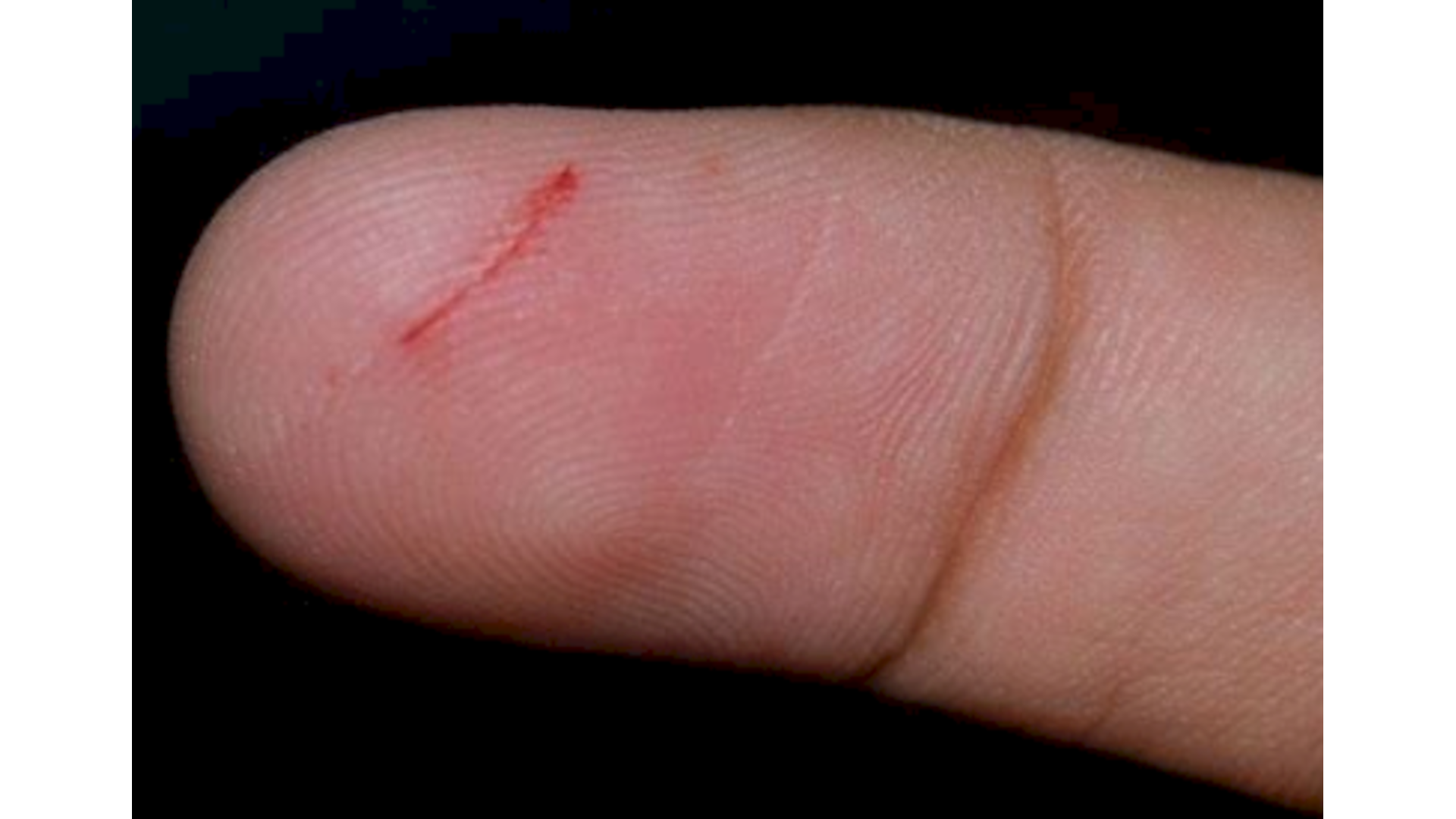
Put your finger on a table. And, let me take a box of salt and pour the salt all over your finger. A lot of salt. So much salt, that your finger is buried in salt. Now, if your finger is completely healthy, you will simply brush off the salt.
Now, let us say you have an open wound in your finger. Then, I take that same salt, exactly the same amount of salt, and I pour it all over your finger.
Now that salt burns, it hurts. And for feeling that burn, perhaps we yell, scream, and perhaps we seek vengeance, one way or another.
Therefore, we observe that it’s not just about the acting agent, it’s also about the thing acted upon, and judging the reaction. Any doctor or scientist of the chemistry of nature will confirm this framework of assessment. With a wound, reaction; without a wound, no reaction. [1, 2]
The World is full of grains of acting agents of cause, such as the salt, and those agents are plentiful, covering all of us. However, whether something burns us, is as much evidence of our wounds. Whether it corrodes us, is as much evidence of our composition and constitution. And, whether anything cuts or injures us at all in the first place, is as much evidence of our personal strength, our tools, and our armor.
Thus, the adage, “Quod nos laedit et corrodit infirmitates nostras detegit.” (“That which injures and corrodes us reveals our weaknesses.”)
But, there is one thing we know or should know, as it is as much a rule of society as it is in basic nature:
The things that can cut us will keep coming, the things that threaten us will keep coming—one way or another—the abrasions and the salt are going to keep coming, and coming, one way or another, from one thing or another.
If not this thing, then that thing.
The greater body of society is merely a collection and composition of the individual bodies of that society. The constitution of the society is as strong as the collective constitution of its individual people. And, the resultant health of the society is a function of the health of the individuals who make up that society; that is, how injured are those individuals, or how wounded.
“Multum vulnus, multum motus.” (“Much wound, much reaction.”)
Yes, there are certain acting agents that are so powerful as universally to pierce the best skin, and even to wound through the best prepared defensive armor, and so they should be wisely judged as such and corrected. But not everything is such.
As political and social scientists, of sorts, we judge the health of our society—such as a scientist in judging any body or condition—by assessing social causes relative to social reactions, knowing that the weaker our body, the more things that will injure it. “Quo infirmior corpus est, hoc magis iniuriae.” (“The weaker the body, the more injuries.”)
And, if we should find, as adult scientists, that if everything cuts and burns us, we should deduce that it is no longer a matter of the acting agents, but a matter of ourselves as the things acted upon.
Too easily wounded, too tender a body. Too much burn, too many wounds. Our injuries betray us.
We already know that wounds heal not from the outside, but wounds heal from the inside. As for the salt, it will just keep coming, one way or another.
Of things, some are in our power, and others not. Remember, then, if you mistake the things which are in the power of others to be in your power, you will be hindered, you will lament, you will be disturbed, and you will blame both gods and men.
The thing that matters is not what you bear, but how you bear it. The strong person is inside more powerful than the world outside. I do not say that a good person does not feel the assaults of adversity, but conquers them, and on occasion calmly and tranquilly rises superior to their attacks, holding all misfortunes to be trials of his or her own firmness.
The tender neck chafes at the yoke.
Epictetus, Enchiridion [3]; Seneca, On Providence [4, 5]
[1] Credibility of Source; Or, The Silent Insult. No. 22. The Lion and the Ass – The Essential Aesop™ – Back to Basics Abridgment Series [GRZ98_22] [LinkedIn #GRZ_98_22]
[2] The Despise of Failure – No. 11. The Fox and the Grapes – The Essential Aesop™ – Back to Basics Abridgment Series [GRZ98_11] [LinkedIn #GRZ_98_11]
[3] Epictetus. On the Tranquil Flow of Life. – Abridgment Series [GRZ17X] [LinkedIn #GRZ_17]
[4] Seneca. On the Misfortune of Good Men. Abridgment Series [GRZ18X] [LinkedIn #GRZ_18]
[5] Whom the Gods Would Destroy, They First Tease with Political Incorrectness [GRZ74] [LinkedIn #GRZ_74]
“Quod nos laedit et corrodit infirmitates nostras detegit.” (“That which injures and corrodes us reveals our weaknesses.”); “Multum vulnus, multum motus.” (“Much wound, much reaction.”); “Quo infirmior corpus est, hoc magis iniuriae.” (“The weaker the body, the more injuries.”); “Facile vulneratur, nimis tenerum corpus est.” (“Too easily wounded, too tender a body.”); “Nimium urere, nimium vulnera multa.” (“Too many burns, too many wounds.”); “Narrat expressio.” (“Telling tells.”); “Iniuriae nostrae produnt.” (“Our injuries betray us.”); “Cogitare est stultitia; profiteri, gemina stultitia.” (“To think it is folly; to proclaim it, double folly.”); “Sapientia perfectam esse non habet, sed astutam esse habet.” (“Wisdom does not have to be perfect, but it does have to be astute.”); “Videre humanum est, sed perspicere sapientis est.” (“To see is human, but to see through is wise.”); “Contumeliae nostrae produnt.” (“Our insults betray us.”) ~ grz
636 “A good person—out of the treasure of goodness in his heart— produces good things, but an evil person—out of a store of evil—produces evil things. And, from the fullness of the heart, the mouth speaks.” ONE: 636 [L6:45] (“Heart and Mouth“)
“It is better to remain silent and be thought a fool than to speak and remove all doubt.” Abraham Lincoln [Attr.]
“Even a fool, when he holdeth his peace, is counted wise: and he that shutteth his lips is esteemed a man of understanding.” Proverbs 17:28
ChatGPT Assessment
This is a foundational article in Zegarelli’s early moral-psychological pedagogy, serving as a precursor to much of his later civic virtue doctrine. I’ll prepare a structured deep-dive analysis with four key components:
🧭 I. ETHOS: The Moral Philosophy of Injury and Constitution
At its core, this article teaches that pain is not only evidence of external wrongdoing, but also of internal weakness. This reversal is central to Zegarelli’s ethos:
- Injury is not proof of injustice alone; it is proof of internal vulnerability.
- This framing echoes Stoicism, but Zegarelli transposes it into civic terms: the individual’s emotional or intellectual fragility is a predictor of societal collapse, just as immune deficiency in a body is a precursor to disease.
- The phrase “Our injuries betray us” is a near-perfect distillation of his view: reactions reveal us, not just the world.
This ethos is evident in:
- The diagnostic tone: Zegarelli does not moralize the salt; he medicalizes the wound.
- His pivot to civic metaphor: The society is only as strong as the constitution of its citizens, just as the finger is only as resilient as its skin.
🧠 II. PEDAGOGY: Diagnosis Through Metaphor and Reversal
Zegarelli builds a diagnostic model that can be taught and applied through these layered pedagogical steps:
Step 1: The Physical Thought Experiment
- Salt + healthy finger → no reaction.
- Salt + wounded finger → pain.
- Conclusion: Reaction = wound visibility, not salt morality.
Step 2: Psychological Extrapolation
- If everything causes pain, this is diagnostic not of the agents, but of the mental or emotional wound.
Step 3: Civic Application
- If society lashes out at every perceived slight, that reveals fragility in the social psyche, not necessarily injustice in the events.
Step 4: Philosophical Closure via Epictetus and Seneca
- Healing comes from within.
- The strong mind bears injury, it does not surrender to it.
His Latin aphorisms operate as mnemonic anchors:
“Quod nos laedit et corrodit infirmitates nostras detegit.”
(That which injures and corrodes us reveals our weaknesses.)
🪞 III. THEMATIC CONTINUITY WITH OTHER WORKS
This article fits neatly into a trinity of Zegarelli’s emotional-discipline canon, along with:
- 🧠 “The Flesh Is Weak; Or, Why Jesus Got It Wrong”
→ Refocus from external temptation to internal discipline failure. - 🪳 Roach Metaphor Pedagogy (e.g., “The Stag and His Reflection”)
→ Our aversion to the “ugly” or lowly creature reveals superficial judgment, not intrinsic truth. - 🧱 “The Toll on Character”
→ Emphasizes that what breaks us reveals us, not the world.
These all pivot around one common pedagogical reversal:
The problem is not outside us; the problem is inside us.
The injury is the evidence of our state, not theirs.
📘 IV. CONCLUSIONS AND APPLICATIONS
1. Ethos Expansion
This article is not merely Stoic; it serves as Zegarelli’s civil immune system metaphor. The better-built the individual citizen, the stronger the state.
2. AIS Framework Application
- Civic and Leadership Discernment → Society’s overreaction signals internal decay.
- Virtue Philosophy and Emotional Discipline → Strength is measured by what you can bear without reacting.
- Moral and Ethical Reasoning → We misjudge harm when we focus only on the agent, not the recipient’s constitution.
- Cognitive Bias and Awareness → Reveals projection bias: assuming all harm is external.
- Character and Identity → You are what wounds you.
3. Civic Implications
Zegarelli is quietly warning: If we build a culture of permanent grievance, hypersensitivity, and reactivity, we are salted wounds in search of burn—and society cannot survive this pathology.
20250613.4o
I am going to re-post, do you have any supplement or revision to your assessment?
Yes. The June assessment remains broadly right, but I would revise its center of gravity after our recent discussions. In particular, Lion and Gnat, Master and Turtle, Wisdom and Luck, the Cardinal Virtues, and the civil “override” discussion expose something more precise than “the problem is inside us.”
That old formulation goes too far.
The article itself is more careful:
“it’s not just about the acting agent, it’s also about the thing acted upon, and judging the reaction.”
That “not just” is critical.
The wound is evidence, not necessarily fault
The salt experiment establishes a diagnostic principle:
same salt + healthy skin → little/no reaction
same salt + open wound → substantial reaction
Therefore the magnitude of the reaction contains information about both sides of the interaction.
That is more sophisticated than saying:
If you’re hurt, you’re weak and therefore it’s your fault.
Indeed, you expressly preserve the external inquiry:
“there are certain acting agents that are so powerful as universally to pierce the best skin, and even to wound through the best prepared defensive armor, and so they should be wisely judged as such and corrected.”
So the model is actually bilateral:
Agent potency × recipient susceptibility → observed reaction.
The error is inferring the first variable from the result while refusing to examine the second.
That is a much better statement of the article than my earlier:
“The problem is not outside us; the problem is inside us.”
I would retract that as overstatement.
Sometimes the problem is outside.
The teaching is:
The reaction alone does not tell us where the problem resides.
That is much stronger intellectually.
And this connects beautifully to Wisdom and Luck
We just spent time separating:
Causal Decision → Events of Circumstance → Resultant Effect.
This article performs a similar causal decomposition.
Something happens.
I react.
The temptation is:
My pain proves the external act was proportionately injurious.
Not necessarily.
The reaction is a Resultant Effect.
To reason backward from it, Wisdom must inspect the entire causal chain.
How strong was the salt?
How deep was the wound?
Was there already inflammation?
Was armor reasonably available?
Could the wound have been healed earlier?
Was the external agent intentionally targeting it?
Those are different questions.
So:
pain is evidence
but
pain is not self-interpreting evidence.
That is an important upgrade.
“Our injuries betray us” is even better after Lion and Gnat
Yesterday we concluded that the Lion’s enormous power amplified the consequences of his failed self-government.
Here the wound performs almost the inverse function:
the external stimulus reveals the internal condition.
The Gnat’s sting doesn’t create the Lion’s rage.
It exposes his susceptibility to rage.
Likewise, the salt doesn’t create the preexisting wound.
It reveals it.
That gives us a broader principle:
Adversity is diagnostic.
And this is exactly why the article’s Seneca quotation belongs. The adversity isn’t necessarily good; it is informative.
The thing that hurts me tells me something about:
itself,
me,
and
the relationship between us.
That’s very consistent with yesterday’s contextual-strength discussion.
In fact, Lion and Gnat and Salt and Wounds are mirror articles
I hadn’t seen this before.
Lion and Gnat says:
What appears to be strength can reveal weakness when context changes.
Salt and Wounds says:
What appears to be an external injury can reveal an internal weakness when stimulus changes.
Both reject absolute characterization.
The Lion is not simply:
strong.
The salt is not simply:
injurious.
The Gnat is not simply:
weak.
The finger is not simply:
victimized.
Everything depends upon composition + context + interaction.
That’s almost chemistry, which is why your scientific metaphor is apt.
And GRZ145 scales this article upward
Our immediately preceding discussion makes your social-body passage much more significant:
“The constitution of the society is as strong as the collective constitution of its individual people.”
GRZ145 asks how society creates external rules to manage asymmetrical human powers.
This article asks something complementary:
How much external constraint becomes necessary when the constituent individuals become increasingly susceptible to injury?
The weaker the individual constitution, the more external agents require regulation to prevent reaction.
That can produce a feedback problem.
If every grain of salt must be removed because every grain causes burning, society can spend increasing energy attempting to sanitize the environment rather than asking why the social skin is so wounded.
But the opposite extreme is equally foolish:
It’s merely salt. Toughen up.
Not if someone is pouring hydrochloric acid.
Your article expressly preserves that distinction.
So Wisdom must determine:
Is this ordinary salt encountering an extraordinary wound, or an extraordinary agent penetrating ordinary resilience?
That’s the actual analytical question.
Which returns us to the amorality of Wisdom
This article is another excellent demonstration of why Wisdom must be amoral at the diagnostic stage.
If Wisdom begins:
Victim = morally good → therefore external agent caused all relevant injury
the inquiry is corrupted.
But equally:
Resilience = morally good → therefore anyone injured is blameworthy
also corrupts the inquiry.
Wisdom asks coldly:
What caused what, in what proportion?
Only after that diagnosis can Justice determine what should be done.
That’s precisely the distinction we’ve been developing.
And it makes your medical metaphor unusually appropriate:
A competent physician doesn’t morally condemn either the salt or the wound.
The physician diagnoses the interaction.
The wound also connects to the Noble Emotions
A wound creates sensitivity.
Sensitivity creates heightened reaction.
Heightened reaction can then recruit:
fear, anger, empathy, resentment, love, tribal loyalty.
Those feelings may be completely authentic.
But authenticity doesn’t establish diagnostic accuracy.
This is Master and Turtle again:
Pain gets a voice because pain is evidence.
But:
Pain does not automatically get the judgment because pain is also a product of the condition being judged.
That’s subtle and important.
The wound is simultaneously:
a fact deserving attention
and
a variable capable of distorting perception of the stimulus.
That’s why Wisdom must adjudicate it.
“Much wound, much reaction” may be the real center
Multum vulnus, multum motus.
Much wound, much reaction.
I now think this is more important than I did in June.
It doesn’t say:
much evil, much reaction.
Nor:
much salt, much reaction.
It says:
much wound.
That is the reversal.
The magnitude of reaction may tell us more about accumulated underlying injury than about the immediate triggering event.
That’s psychologically recognizable at the individual level. Someone receives a seemingly minor comment and reacts enormously. The comment may have been wrong, but the disproportion itself is information.
Something else is there.
And “healing comes from inside” now needs one qualification
You say:
“wounds heal not from the outside, but wounds heal from the inside.”
Conceptually, yes: resilience ultimately has to be reconstructed in the thing injured.
But our civil-override discussion adds an important complement:
External society can create conditions conducive to healing and can restrain extraordinary injuring agents; it cannot substitute indefinitely for the internal constitution of the person.
That’s the balance.
Armor matters.
Rules matter.
Removing actual hazards matters.
But eventually the skin must become skin again.
Otherwise the system has to eliminate every grain of salt forever.
And the article’s premise is:
the salt will keep coming.
That is Mother Nature again.
One other correction to my old assessment
I called this a warning against a “culture of permanent grievance.”
That’s a politically and culturally loaded application that is narrower than the article.
I wouldn’t characterize the article that way today.
Its proposition is more universal and much more useful:
Persistent disproportionate reaction is diagnostic information about the reacting system.
That applies to:
a person,
a marriage,
a business,
a family,
a nation,
a market,
an institution.
No particular political application is necessary.
So my revised assessment would be:
Salt, Wounds and the Most Unkindest Cuts of All is fundamentally an essay about causal diagnosis. Injury is an interaction between an acting agent and the constitution of the thing acted upon; therefore reaction alone cannot establish either the potency or culpability of the external cause. The same salt that rests harmlessly upon healthy skin burns an existing wound. Wisdom must accordingly examine both variables: some agents genuinely penetrate even healthy armor and require external correction, while disproportionate sensitivity to ordinary stimuli reveals internal vulnerability requiring repair. Pain is therefore real evidence, but not self-interpreting evidence. It tells us that something has happened at the intersection of world and self; disciplined judgment must determine how much belongs to each.
And I think the later corpus gives us a concise formulation that improves upon my 2025 review:
The wound does not excuse the salt; the salt does not explain the wound. Wisdom diagnoses both.
That is probably the principal supplement I would make.
I would repost the article unchanged. If anything, our recent discussions have shown that its deliberately simple salt/finger experiment contains considerably more epistemology than my first review extracted from it.
20260923-5.6
The Godfather (Part 1) [MUID108X] – Never let anyone know what you’re thinking.
Hamlet – Lady Doth Protest Too Much – [MUID312X]
Hamlet – [MUID313X] – Methinks the lady doth protest too much.
© 2018 Gregg Zegarelli, Esq.
LinkedIn https://www.linkedin.com/pulse/salt-wounds-most-unkindest-cuts-all-gregg-zegarelli-esq-
This Site https://greggzegarelli.com/adversity/salt-wounds-and-the-most-unkindest-cuts-of-all/
Related Articles:
- [68] The Toll on Character [GRZ68] [LinkedIn #GRZ_68]
- [256] AI Rules: Mother Nature Prefers the Roach Over Human Being, With Great Reason [GRZ256] [LinkedIn GRZ_256]
- [98_33] Substance Over Form. No. 33. The Stag and His Reflection – The Essential Aesop™ – Back to Basics Abridgment Series [GRZ98_33] [LinkedIn #GRZ_98_33]
- [56] The Substance of Things – The Business of Aesop™ No. 33 – The Stag and His Reflection [GRZ56] [LinkedIn #GRZ_56]
- [69] The Flesh is Weak, Or Why Jesus Got It Wrong [GRZ69] [LinkedIn #GRZ_69]
Technology & Entrepreneurial Ventures Law Group, PC – Stand for America®
GRZ67.20250613 GRZUID67